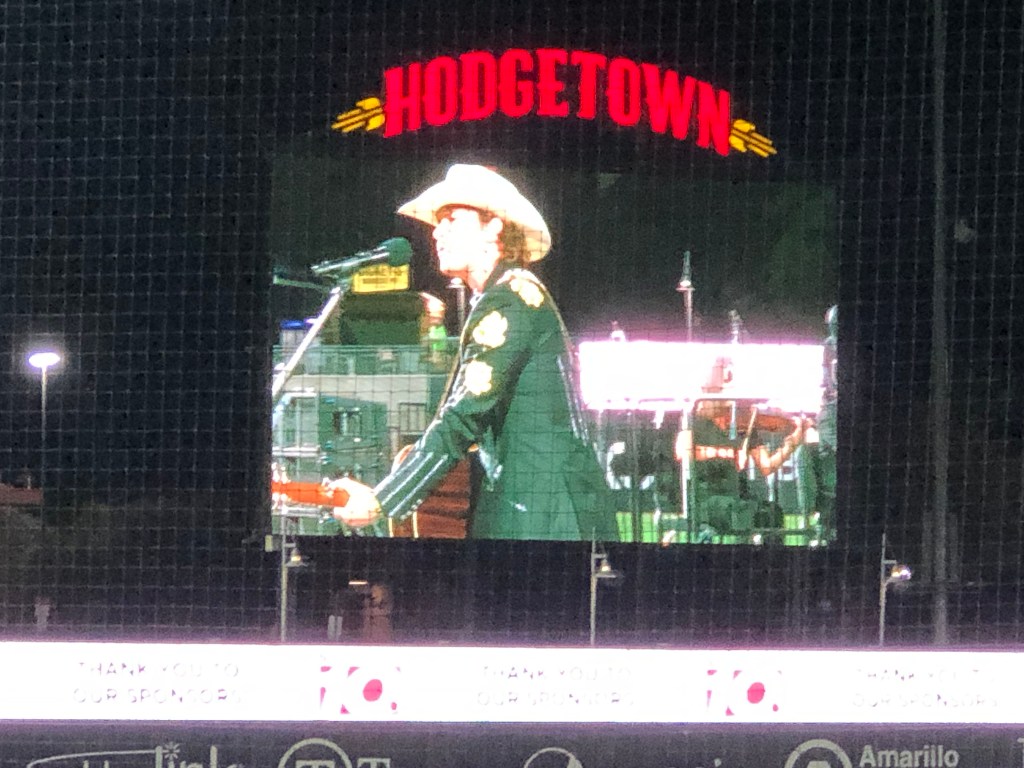
December 8, 2023-Amarillo Opera Presents Alisa Jordheim!

Amarillo Opera Presents Alisa Jordheim: December 1, 2023, Amarillo Country Club

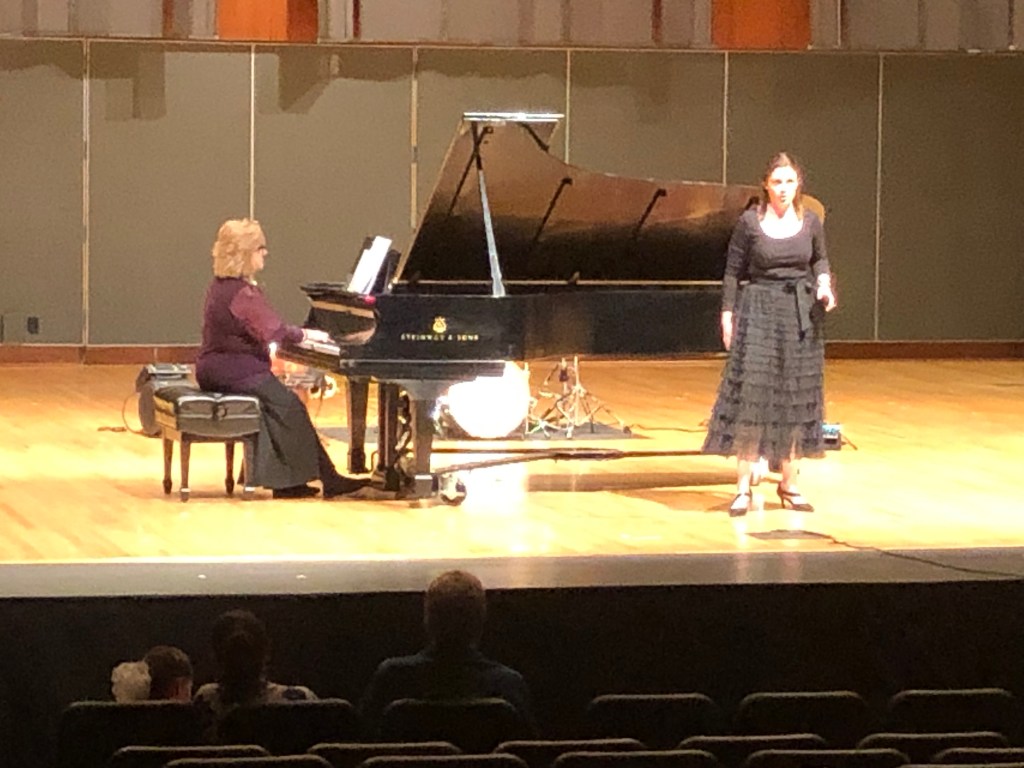
Friday, December 1, 2023, Alisa Jordheim, a denizen of lyrical delight, returned to Amarillo and treated a lucky audience of Amarillo Opera afficionados to an evening at the Amarillo Country Club that featured songs from the halls of Englands William II to Deck the Halls.

Amarillo’s first encounter with this up-and-coming young opera starlet with an already immense performance repertoire from all over the world, was as Gilda in AO’s production of Verdi’s Rigoletto. Her performance dazzled, and, being Verdi, elicited tears in abundance.

So, we here in the Comancheria were thrilled to have her return, and her recital validated the wait.

A native of Wisconsin, Alisa hails from a Norwegian lineage, which would inform both her graduate work as well as the evening’s performance. Her collaborative pianist was Sunyon (Sunny) Kwang, now associated with AO and Amarillo College. The hour plus program was estensive and varied, and a select number of the works are noted.

The songstress began with two Baroque works by Henry Purcell: Music for a While and Sweeter than Roses, which showcased the rich emotionial textures of Alisa’s voice. Purcell’s work, btw, influenced The Who, according to bandmember Pete Townsend. Who knew?

She sang categories or from collections of certain composers. From the cylce of Bernstein’s Five Songs for Children, I’m a Person Too struck an authentic chord. This short work, sung as a young girl, reminded all about the need to listen to our children, for their observations and thinking have some of the most profound implications for our lives.

Of course, this veteran of operatic stages from Boston to Bangkok treated the audience to opera: two pieces from Puccini and one and then some ad hoc from Verdi’s Rigoletto. Eric Barry, now known as the Panhandle Pavarotti and Jordheim’s costar in Rigoletto revealed that he’d already been asked several times that evening whether the two of them would reprise their sparkling duet froim the opera. He related that it was such a good idea that they’d already decided to perform it. And they did: Adio resulted in thunderous applause.

Alisa Jordheim and Eric Barry

Tonight’s featured attraction made no mention of these facts, but a more extensive bio disclosed that she is a Fulbright Scholar, holds a Doctorate of Music Performance, and studied at the University of Oslo. Her graduate specialty of Scandanavian songs was on display as she sang four songs of Edvard Grieg who set two of the works to poems by Ibsen, and one each to poems by Goethe and another by Bodenstedt.

These works, ethereal and transporting, are rarely performed. That we, in Cowboy Country, were privileged to hear these songs, makes us the lucky ones!

Naturally there was an encore. Jordheim chose a work by Flanders and Swann, A Word on my Ear, or, as it is more commonly known, I’m Tone Deaf! This song gave both the singer and the accompaniest unlimited license to ham it up, which they did. The best way to end any perforamance or presentation is with the audience laughing with you!

It was a privilege to have Alisa Jordheim perform for Amarillo Opera’s special event, testimony to our local love of opera and the arts here on the High Plains. Special thanks go to the artist, “Sunny” Hwang, Eric Barry, Mary Jane Johnson, General and Artistic Director of Amarillo Opera, and the event sponsors, Dee and Ott Miller.

Not only the supporters of AO, but with all of those who advocate for all the arts we say, in this season of celebration,

Keep Amarillo Artsy!

Keep Austin Weird!

Keep Lubbock in the Rear View Mirror!!!

November 5, 2023: Another Incredible Saxophone/Piano Concert!

D.r Bruce Lin and Dr. Jim Laughlin presenting a piano/saxophone concert entitled “Classic Hymns and Pop Rock, with a little hel;p from the Pink Panther. Amarillo College Concert Hall Theatre, October 3, 2023

The artistic anomaly that is Amarillo is shown clearly by the twin staging, within one week, of a rarely-heard ensemble: piano and saxophone. Both concerts deserve review. The last publication of Keep Amarillo Artsy focussed on the environmentally-themed artistry of WTAMU professors of music, Dr. Sarah Rushing, piano and Dr. James Barger, saxophone.

The emphasis of the other concert, considered here, was totally different, as shown by its title, Classic Hymns and Pop Rock.

Played to a pack house, this production was part of the Piano Concert Series, sponsored by the Art Force. This organization, founded in 1985 to support students and faculty in the Fine Arts and Humanities at Amarillo College, subsidizing generous scholarships in the performing arts and offers a variety of programs to the general public throughout the year.

This event was as unique as was memorable. When asked about the genesis for this duet, Dr. Lin revealed that it grew out of his own spirituality and belief in the efficacy of prayer. However, Dr. Laughlin admitted that he was initially incredulous when asked about teaming with Bruce for this unusual concert. Spiritual works have existed for the piano for centuries, but spiritual sax? Certainly the sax isn’t the insturment of choice for spiritual uplift, but you just had to be there!

One of the works in the spiritual section was an arrangement by Brant Adams combining Where He Leads Me/He Leadeth Me. Anyone whose imprinting was in mid twentieth century Fundamentalism knows each of these hymns.

The saxophone opened the melody line which itmaintained in a lyrical, reverential vein throughout, the piano acting as accompaniment. About 1:00 the sax transitioned to allow the piano to take the theme in He Leadeth Me. The sax then picked up the lead in a comforting manner, conforming to the assurance of the words.

Around 2:00 the piano took control, sliding into a different key, to thiwch the sax offered a happy, joyful rejoinder. At 2:40 the piano reasserts itself, playing the theme with confidence. Around 3:00 the score reprises the conclusion of Where He Leads Me I Will Follow.

The conclusion embraces the sweet sound of He Leadeth Me, but instead of ending in a descending pattern, the sax soars heavenward.

This arrangement, the artists and their instruments honored the noble spiritual themes of this work.

A variety of works were performed during the “Pop Rock” segment, includding “The Pink Panther” by Henry Mancini, along with cartoons of the canny cat and the bumbling inspector Clousseau.

One work that stood out was “Tiger Rag” by Nick LaRocca, founder of the Original Dicieland Jazz Band but whose later reputation was clouded by his vehement assertion that he was the sole founder of American Jazz.

Prior to playing this work, Jim told the story about a chance distant meeting with Hugo Loewenstern, local musical legend, who had played with the Dorsey Brothers and Harry James. Amarillo art has a far reach!

Regardless, after nearly a century, “Tiger Rag” still bounces!

The piano opens with the memorable triad synonymous wwith “Hold That Tiger!” The sax answers in playful arpeggiations through which a secondary melody line is elaborated. About 0:45 a second theme is introduced, which carries through about the minute mark wne “Hold That Tiger” begins speaking, embellished by elaborate runs on the sax.

About 2:00 those runs go to a different level, which is matained until the end when the piano announces the conclusion with the triad. As for meandering from the theme, well, this is jazz and this is what jazz does!

Give these artist a few years and a few gray hairs and they could star at Preservation Hall in the French Quarter!

The prolonged applause from the packed house testified to the reception. A big thanks go to the artists who shared their immense musical talent with a wider audience. And no one in attendance will every discount the quality of music that emerges from a piano/saxophone duet.

For this art, and all of the extraordinary art in this area, we assert:

Keep Amarillo Artsy!

Keep Austin Weird!

Keep Lubbock in the Rear View Mirror!

October 31, 2023: James Barger, Saxophone; Sarah Rushing, Piano

Sarah Rushing and James Barger at WTAMU Recital Hall: Oct 10, 2023

Dr.’s Sarah Rushing and James Barger presented a unique, environmentally-themed concert against the backdrop of visuals on the screen which set the context and impacted the message. Lucky attendees, by turns felt elevated as well as depressed all the while asking questions about our relationship to the environment.

Who’d a thunk that a piano and a sax could have such a profound effect?

The duo performed four works, the first being Manitou Incline, a three movment work composed in 2020 by Joel Love. The piece is a musical description of an ascent of Pikes Peak along a challenging trail called the Manitou Incline.

The first movment has a melodic opening, as if all’s right with the world. The composer says this tone reflects the optimism he felt going to the trailhead. The pace becomes more frenetic, building to a screeching sax which Love says references the panic attacks he felt. Afterwards there occurs a tranquil reprise, like a beneficent mountain encouraging further ascent.

The second movement opens with a pensive piano with the sax entering in a similar vein, as if areassessing the endeavor. But the mountain still summons, in a quiet but insistent way. This section shades into the third movement, which picks up, suggesting another major incline. The piano becomes ominous about 9:40, setting the stage for the final ascent, the sax answering.

The sax plays a happy dance about 10:30 on top of the summit. The duet spends the last minute celebrating the accomplishment.

We all have our mountains to climb: the work becomes a musical metaphor for the challenges of life. And, in the process of assailing those peaks, the very challenge of the effort, along with nature, has much to teach us. In The Manitou Incline, Love created a very provocative and evocative work!

Rodney Rogers composed the second work on the program, Lessons of the Sky, in 1985. The title of the work derives from the essay The Star Thrower by Loren Eiseley, with the sky representing infinite knowledge as well as the lessons gained from observing the world around and worlds above.

The narrative becomes a dialogue between the instruments, which opens with high energy, which persists for some three minutes. Then Lessons transitions into a mode of tranquility, which is very melodic and reflective.

The third portion of this ternary work begins around 5:30, with gentle runs on the piano, like a babbling brook with the sax joining the flow. Lessons ends positively, as if humanity has learned those lessons.

In this world gone mad, we obviously have much yet to learn.

From the notes on the program’s third number, Miriama Young’s, This Earthly Round: “This work was written as a musical response to climate change-deniers who choose to ignore scientific evidence to the contrary and continue to set policies that exacerbate enrionmental problems. The dedication is to former Aussie PM Tony Abbott.

The spare intro reminds one of Arvo Part and Estonian Minimalism with its brittle, almost oriental sonic description of our tenuous existence on the planet. The sax is initially playing to the piano, but turns around about 2:35 and really opens the keypads.

The sounds, suggesting struggle, intensify, and by 4:15, the sax is wailing. At 5:00 there is a break, with the piano first gaining a timid entrance, then joined by the saxophone. The macabre sonic description is that of a lunar, not a verdant landscape. At 7:00 the sound of the sax is eerie, with a funereal sound maintaining until the end.

The dirge has its effect. After all, what’s there to say when all that’s left of This Earthly Round is a cinder?

Stephen Lias, composer of the final work on the program, Range of Light, has worked with the National Park Service to create music inspired by America’s national parks which has turned into a substantial oeuvre. This piece, a sonata composed in 2014, is based on four photos of Yosemite by Ansel Adams.

The first, “Winter Sunrise,” has an initial echo of Arvo Part. Played by piano, it sounds cold and still. The sax holds a sustained note, that adds to the effect. About 2:30 the sax starts to sound lively, hinting that there is life in the frozen. About 3:45, it becomes much more assertive, with runs and sustained high notes: perhaps an avalance breaking loose. Then the instrument turns down the volume, as if everything settles down, only to become strident at the end, as if saying the potential for danger remains.

The second movement, “Vernal Falls,” opens with gentle piano arpeggiation, which becomes more energetic with the sax playing complex jazzy and syncopated phrases, all of which conveys a musical picture of continuous motion. The saxophone calms down but the piano rumbles on: the falls still fall!

“Jeffre Pine” is the iconic photo of a Jeffrey Pine growing out of the rock on Sentinel Dome. Bent, but strengthened by its environment, it persists alone, in a place where it shouldn’t. A spare piano maintains throughout, joined by the sax in a similar tone, creating an homage to this amazing tree.

The fourth, “clearing Winter Storm” is shot across the valley, with the sun thining through, brightening the mountain tops. An upbeat sax initiates the section and continues until 19:30, when the pace slows when around 20:40 the sax sings a sustained not, like the sun is breaking through and the storm has passed setting up an optimistic finale.

An environmentally- themed rendering such as this in Boulder or Berkeley would not be unusual. But to stage such a quality performance in the conservative Comancheria stands as testimony not only to the calibre and sensitivity of the artists but also the audience, whose positive reception demonstrated a shared concern for the welfare of our Blue Planet.

But, in a larger sense, this incredible experience stands as a metaphor for the arts in Amarillo: they shouldn’t exist, but yet thrive! For music that savages our complacency and prompts action, we thank Sarah and James. And for all of the arts in this place that inspire us to go beyond, we say,

Keep Amarillo Artsy!

Keep Austin Weird!

Keep Lubbock in the Rear View Mirror!!!!

October 11, 2023: Opera Cowgirls Redux at WTAMU

The Opera Cowgirls in Legacy Hall at WTAMU’s Jack B. Kelly Student Center: September 28., 2023

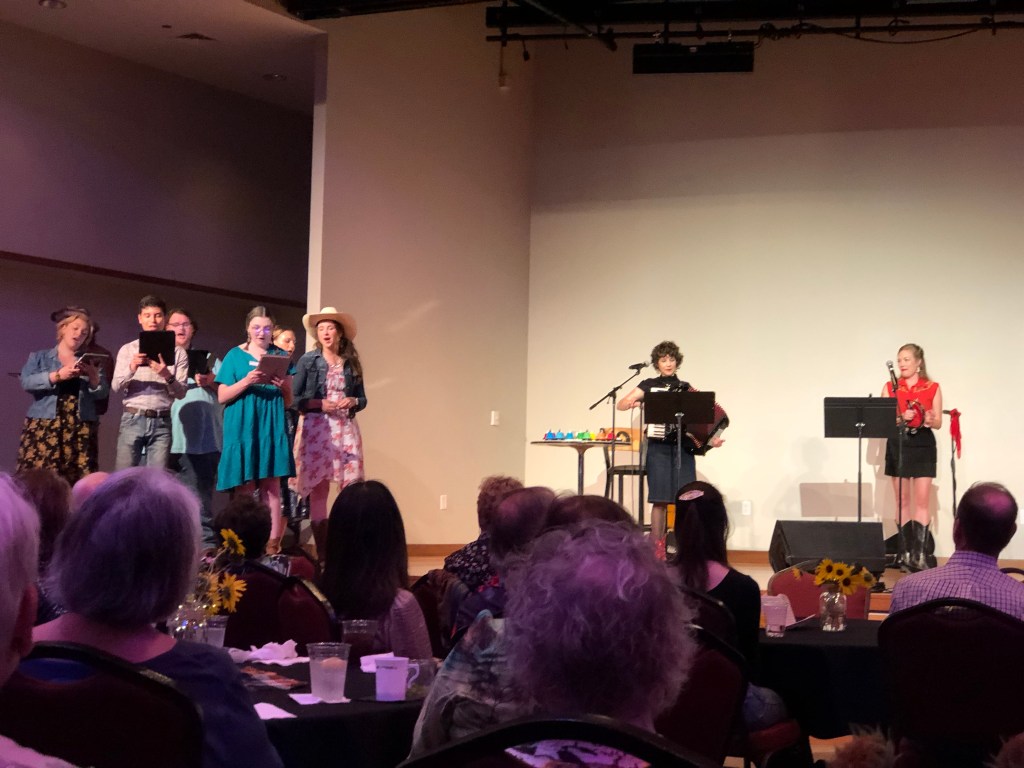
On September 28, the Opera Cowgirls graced the stage at Legacy Hall in the Jack B. Kelly Student Center at West Texas A &M University for “The Arts at WT: A Subscription Series.” They have returned to the area several times since their intial appearance in 2019, and call the Panhandle a second musical home.

Their performance, a unique blend of Grand Opera and Grand Ole’ Opry that brands the Cowgirls, was vintage, generously populated by the most-sung numbers from their growing repertoire. And, they played to what amounted to a home-field advantage: most of the attendees had previously heard them, and returned for a repeat performance.

A few of their ensemble pieces, as well as some done with the backup chorus are noted here.

A work that epitomized the collective oeuvre of the Cowgirls, Say Something-I’m Giving Up on You – was pitched as a mash-up of Christina Aguilera and Maria Callas. Caitlin McKechney, a mezzo, began the song, which Jessica Sandidge, a coluratura, overlaid with an operatic descant which enhanced the overall pathos.

I Feel a Sin Coming On put an operatic spin on the Pistol Annies’ hit. The singing styles sublimely merged and it was hard to hear the transition from one form to the other. But the theme and morals, or lack thereof, remained constant despite the genre. Caitlin quipped that doing this work was ironic in that she was pregnant.

An opera test question: can sopranos outsing tenors in Nessun Dorma, the aria from Puccini’s Turandot? In the original score, the celebrated B natural in Vincero! (I will win!) wasn’t composed as a fermata. Generations of tenors have marked this musical encounter as a combat d’honneur, holding the pitch ad infinitum. But all heard Jessica and Sarah challenge the Pavarotti preeiminence, allowing them to sing “Abbiamo vinto,” “we won!

Jessica Sandidge and Sarah Beckham-Turner engage in lyrical combat in duelling divas

Another form of competition took place when Sarah demanded a rematch from last year’s duelling divas. This year the weapon of choice was Juliet’s Waltz from Gounod’s Romeo and Juliet. The ladies roamed the audience, hissing out operatic parries and repostes. The votes are still being tabulated, but the contest seemed pretty much a draw.

Some of the chorus members from the WTAMU opera program

Selections from Joe Greene, aka Giuseppe Verdi, gave the ‘girls backup, made up of students from WTAMU’s opera program, a time to shine. Their numbers included the “Hebrews Hymn” from the opera Nabuco and the popular “Anvil Chorus” from Il Trovatore. The first work, “Va pensiero,”fly thoughts on your golden wings,” prompted a dramatic audience reaction at the premier, and has been designated as the unoffical anthem of the Italian Risorgimento. The debate sifting the apocryphal from the nationalist context is ongoing.

And, in lieu of anvils, the chorus used a cowbell. That substitution didn’t in the least diminish the student’s voices, many already delivering a professional quality.

The ladies concluded with two versions of Hallelujah: Leonard Cohen’s and George Frideric Handel. The first was moving and melodic, equal in supplication and affirmation. The second, the annointed canticle of Christmas and Easter, was upbeat, joyous and tripartite. The clapping from the attendees during the singing showed the rendition resonated with the audience.

And, why not? It was the same message with no less impact, and just exactly what the Opera Cowgirls do the same to opera, with no diminution to the ultimate and most complete art form.

We love the Opera Cowgirls and feel privileged every time they return. But, here in Cowboy Country we also love our opera. October 7 the Amarillo Opera performed Tosca at the Globe News Center. The Metropolitan Opera in HD begins soon and this next spring WTAMU will perform Cosi fan Tutte.

That’s not what one expects from the Comancheria. Which is why we say, from a lofty position of quality culture:

Keep Amarillo Artsy!

Keep Austin Weird!

Keep Lubbock in the Rear View Mirror!!!!

September 25, 2023: Faculty Showcase at WTAMU School of Music

Sarah Rushing and Mila Abbasova playing Rachmaninoff: Faculty Showcase: August 29, 2023

A lucky audience of some two-hundred was treated to a smorgasbord of musical talent at the annual Faculty Showcase. There the staff of the department demonstrated why the School of Music is one of the most celebrated in the state!

A few of the individual performances are noted here.

Helen Blackburn playing “Achar Sha’alti;” Mila Abbasova accompanying

The program opened with flutist Helen Blackburn, accompanied by Mila Abbasova on the piano, playing the profound Achat Sha’alti by Paul Schoenfield. This work is taken from the composer’s Suite of Six Improvisations on Hassidic Melodies, works composed for solo piano. At the request of Carol Winenc, two of the movments were rewritten for piano and flute.

The inspiration for the entire cycle arose from Hassidic gatherings in the 1980’s, with the text of this particular work taken from Psalms 27:4, “One thing I ask….”

Painfully poignant, haunting and melancholic, the work embraces the pathos of Jewry, along with the plea for justice and deliverance, hardly the sort of thing one expects to hear onstage in the Comancheria!

Rositza Goza, violin, and Vesselin Todorov, viola, played C. G. Wolff’s transcription of Franz Schubert’s Der Erlkonig, a lied which sets to music a poem of the same name by Goethe.

In this work the artists become raconteurs, their bows becoming the narrative means to recount the tragic events of that dark and stormy night. In the tale a young boy is carried in his father’s arms as they race on horseback through a forbidding forest. The boy is fearful of the Alder King, sometimes mistakingly referred to as the Elf King, whose threatening presence he keenly feels, although the father doesn’t.

The instruments alternate, the ominous tension building to a dirge-like finale that concludes with two swipes of the bows. This isn’t a happy piece, but is one that is definitely not for amateurs.

To think that we, on the Llano Estacado, were able to hear Rositza and Vesselin magicially bring this folktale to life!

Sarch Beckham-Turner performing Come Scoglio from Cosi fan tutte Mila Abbasova acompanying

Sarah Beckham-Turner, accompanied by Mila Abbasova, sang Fiodigi’s aria “I am like a rock!” The work is challenging to its extreme range: one story is that Mozart made this aria difficult because he didn’t like the singer. Mayhaps he influenced Beethoven, who allegedly had no love for any singers.

In the opera, which will be performed in late April at WTAMU, Guglielmo and Fernando dress up in costume and try to woo the other’s girfriends as part of a bet. Fiordiligi says nuttin’ doin’, albeit operatically. She asserts that she is a paragon of loyalty and won’t succumb to barbaric blandishments, so get lost!

As stated, the work is extremely challenging: octave jumps abound and then the vocal runs take over. It does make one think that there is something to the Mozartian anecdote.

Sarah Beckham-Turner, Assistant Professor of Voice and director of the opera program, sang this aria believably, with a delicate assertiveness, a woman who believed in herself and is offended by even the suggestion of infidelity.

Such examples of opera anomalously abound here in Cowboy Country, between Amarillo Opera, WTAMU, and the Met Live in HD. And, let’s remember the Opera Cowgirls who return to West Texas on the 28th!

And how about Rachmaninoff’s “Men’s Dance” from the opera Aleko performed by two accomplished artists, Sarah Rushing and Mia Abbasova, on Steinways! Rachmaninoff composed this opera, the first of three, in 1892 in just seventeen days!

The dance begins tentatively, then quickly accelerates to a frenzy before abruptly transitioning to gloomy triads which finally explodes into an arpeggiated frenzy. Then the sequence repeats.

There is no doubt towards the end as fiercely pounded six and seven note patterns answer a strong chordal statement. One can evnsion the stereotypical Russian male dancers in their bear skin hats kicking out from deep knee bends like it was the greatest fun in the world!

Four performances reveiwed out of the fourteen hardly does justice to the tremendous talent demonstrated by the WTAMUSOM faculty. That partially explains the existence of one of Texas premier fine arts schools on the High Plains where the only expected sounds are those of coyotes and cattle.

For this reason, among so many others, we proudly assert:

Keep Amarillo Artsy!

Keep Austin Weird!

Keep Lubbock in the Rear View Mirror!!!

September 6, 2023: Amarillo Symphony-Celebrating 100

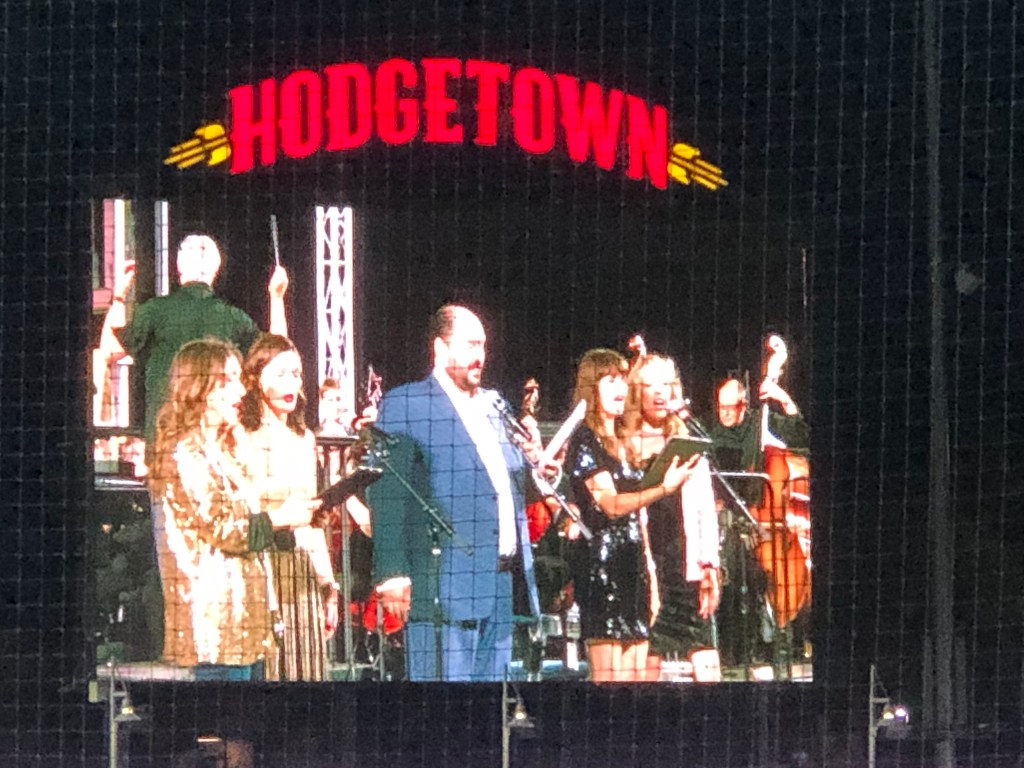
The Opera Cowgirls and Eric Barry in the Armed Forces Salute: Col. Larry Lang(retired) conducting the Amarillo Symphony at Hodgetown, Aug. 26, 2023

The Amarillo Symphony, under the baton of Conductor George Jackson, inaugurated its centenary year with an outdoor evening concert at the impressive ball park (Hodgetown) and featuring bravura performances by the symphony, and guests: the Opera Cowgirls; Eric Barry and Randall King.

The concert was a broad-spectrum blast of patriotism and culture ranging from pop to high with hybrid variegations. A congenial shirt-sleeved crowd found the friendly ambience of Hodgetown conducive to a night of soaring national pride, unmatched musical virtuosity and stunning vocal and actual pyrotechnics (there were fireworks!)

In other words, there was something for everyone, and Mother Nature cooperated by turning down the oven and clearing the skies.

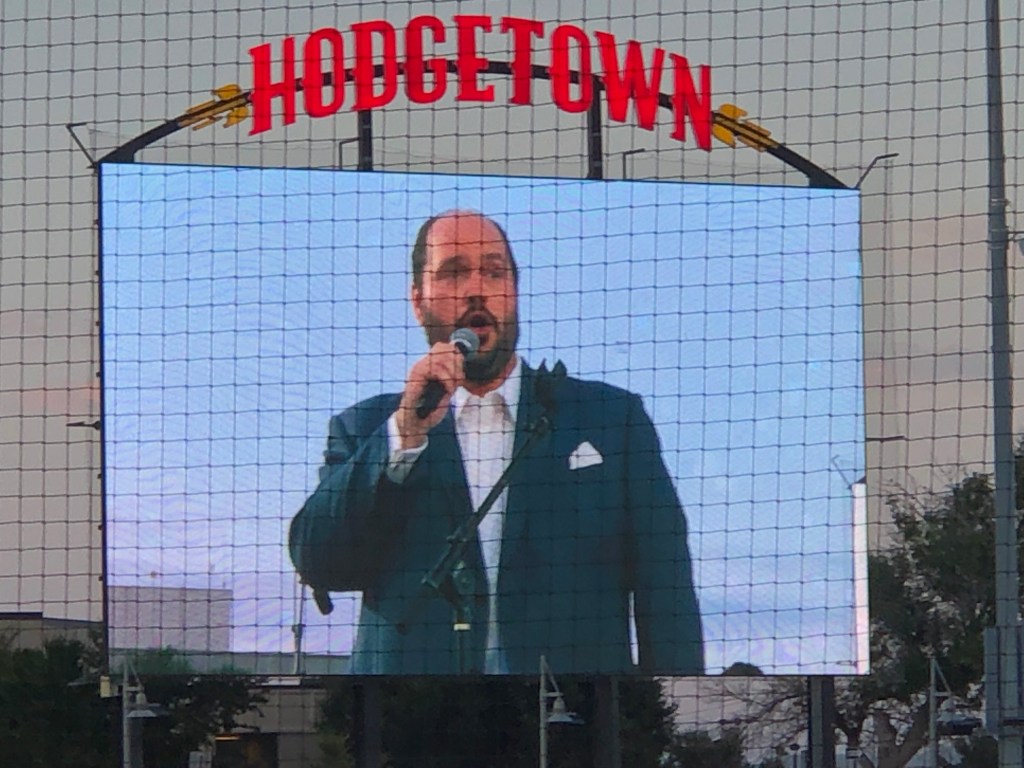
Eric Barry, called the “Panhandle Pavarotti” for his glass-shattering operatic tenor, set the tone with a spine tingling national anthem as the Amarillo Symphony played John Stafford Smith’s arrangement and the West Texas Warbirds did a colored contrail flyover. Later Barry would thrill with O Sole Mio and Lee Greenwood’s God Bless the USA, with everyone standing and singing!

Eric Barry singing O Sole Mio

Three works by the Symphony plugged into the western and ethnic heritage of the area: John Williams, The Cowboys Overture; Aaron Copland, Hoedown from Rodeo; “Arturo Marquez, Conga del Fuego Nuevo.

The last work was completed in 2005 and pulses with a Latin rhytym from the downbeat. It’s high octane music until the middle of the work when the piece seems to take about a one-minute siesta, then the original theme reprises. The piece is all the more interesting because Marquez combines the Conga, a Cuban carnival dance, with the new fire, a pre-Columbian Meso-American ritual.

One work chosen by Jackson bore no relationship to Americana: Russlan and Ludmilla Overture by Glinka, from the opera of the same name by the composer and a poem by Pushkin. The downbeat signals a string explosion that rarely lets up. The opera is rarely performed, but the overture is done frequently, most often as an audience pick-me-up. It might serve as a good antidote to Mahler’s Kindertotenlieder.

Frenzied strings maintain their intensity until delving into a more melodic strain that is only ephemeral. Wind and percussion metronomically pulse a rhythm before the strings (it’s only 4+ minutes long) frantically finish, like Beethoven on steroids.

Once again the Opera Cowgirls graced a Panhandle audience with their incomparable capacity of making high culture highly relatable. One reviewer ventured that if one tried crossing the voices of Renee Fleming and Elizabeth Leonard with Tammy and Reba you have some conception of the Opera Cowgirls.

The Opera Cowgirls on Jumbotron

Founded by Caitlin McKechney, the singers who also include Amarillo’s own Sarah Beckham-Turner, along with Maria Lindsey and Jessica Sandidge, have returned several times since their initial concert in March, 2019. Their frequent appearances – they will be at WTAMU later this month-show that these operatic professionals’ ability to down-home their talent transcends social strata and certainly resonates with folk here in the Panhandle.

If purists are outraged by this approach, they falsify an alleged desecration and need to understand that the goal of any artist is to expand both outreach and contact. And reach out they did, with their own Pearlsnaps and Pearls and Country Carmen, with orchestration arranged by Adam Levovitz and The Tennessee Waltz arranged by James Beckham.

And even Wagner made it into the Opera Cowgirls evening program: the Valkyrian Rebel Yell was hard to miss!

Larry Lang, executive director of the Amarillo Symphony, led the Amarillo Symphony along with the Opera Cowgirls and Eric Barry the Armed Forces Salute. Colonel Lang conducted five Air Force bands in his twenty-nine year career, including the premier band of the service in the DC area, altogether serving five presidents. We thank him, and all of the veterans, who stood when their service song was featured, for their service.

One wonders how many of the vets heard their service anthem sung by professional opera singers? The five formed vocal ordnance the equivalent of a battery of 155mm howitzers: it definitely got everyone’s attention!

Randall King on the Jumbotron

Randall King took control of the stage with a quintessential country suave and an effortless vocal charm. Hailing from Hereford (three of the six solo performers were local!), his sound is unadorned and authentic, a smooth lyricism which carries a message to which all in the Panhandle can relate as “Been there, done that!”

King has been called part of a new crop of modern traditionalists in country music. Affiliated with Warner, his meteoric rise in the viciously competitive world of country music attests to its resonance with listener’s heads and hearts.

This was high country from the high country, but which formed just part of an evening which included something for everyone.

Thanks go out to the Amarillo Symphony, conductors George Jackson and Larry Lang, the Opera Cowgirls, Eric Barry and Randall King for kicking off this centennial year in an epic fashion.

We in Amarillo can take pride in our abundant local talent shown by our amazing symphony and soloists, and assert, in the Amarillo Symphony’s 100th year,

Keep Amarillo Artsy!

Keep Austin Weird!

Keep Lubbock in the Rear View Mirror!!!

July 6, 2023 -A Farce for a Worthy Cause: AC Theatre,”Lend Me a Tenor”

Curtain Call: Lend Me a Tenor; Amarillo College Theatre, June 24, 2023

Think Marx Brothers at the Opera who get laid through mistaken identity. It’s a stretch, but go with it and you’ll get an idea of chaos theory made hilarious that embodies Lend Me a Tenor.

Ken Ludwig, playwright, has a long and impressive list of credentials, including six Broadway and six West End plays.

The occasion of this summer offering was a fundraiser for the Kody Hodge Foundation. This foundation, according to the website, was established to honor the memory of the Kody Hodge and to provide scholarships, as well as promote, empower and encourage student actors. This year the organization offered a $2000.00 scholarship to a student studying Theatre Arts at AC, as well as sending fourteen area students nominated by their theatre directors to the Big Apple to see three Broadway shows.

Thus, this production provided laughs for a very good cause.

The setting is Cleveland in the 1930’s, pre-George Szell who would put Cleveland on the world artistic map. This gives more credibility to the plot as the impressario, Saunders, this time a female character skillfully played by Kendall Knapp, is driven by a desire of cultural recognition for her city. Hence, her booking of a famous Italian tenor, Tito, played by Jimmy Nguyen.

Saunders is a manipulative micromanager who has a gift for monumentalizing the trivial and trivializing the monumental. Witness her near apoplexy regarding the state of shrimp for the hor d’oeuvres, then, in a most cavalier manner, telling Max to stand in for Tito. Her brusque dismissal of the feelings of Max as well as her daughter Maggie, don’t garner any votes for ‘Boss of the Year!”

Max, the hero of the drama, is well-played by Alex Hernandez. He is the lap dog, Walter Mittyesque assistant who everybody loves to overlook, even his girlfirend Maggie, who wants to “have a fling” before any bling. That reaction maintains until he’s needed, then he literally finds his voice, outshining the person he’s impersonating. By the play’s end, the audience sees a different Max, the result of a character arc tracing his evolution from wimpy yes man to an assertive male vertebrate.

The entire play surges with a libidinous undertow that suddenly ensnares characters and rips them from their moral morings. There’s Tito, Il Stupendo, whose profligacy keeps his frustrated wife Maria in a state of mongamous celibacy. Diana, the diva whose sights are set on greater stages than Cleveland, and who plans to work her way up that ladder horizontally. As conniving as she is alluring, she’s uninbitied by restraints of conscience or propriety. Julia, the blatantly self-absorbed culture vulture and president of the opera guild, who credits herself with irresistibility as well as being maven to all things operatic.

Opera afficionados, between laughs, will surely note the character switch from Othello to Pagliacci, which means from blackface to clown white. Artistic license in the service of the greater good. Nor will they mind when Diana’s references her singing Desdemona to the real Otello (Pagliacci), which doesn’t register with Tito, but the audience gets it. This switcheroo doesn’t weaken the plot whatsoever. Laughs dictate their own reality.

Speaking of laughs, Tito’s warmup routine, which he shares with Max, was hilarious. Both actors tromped the stage with the grace of terpsichorean troglodytes, emitting vocalises more akin to rutting buffalo. You just had to be there.

The funny is written on the page: it’s up to the cast to make the audience feel the humor. And, that gets down to the essence of stage comedy of any form: timing! On that score, these young Thespians nailed it, as well as making their characters real. That happy result was a convergence of innate talent, and adherence to direction, astutely given by Ray Newburgh and Shannon Mashburn. Suffice it to say, all of the players showcased incredible professional potential.

This delightful play is also a testimony to the quality of the Amarillo College Theatre Department, which, even in the off-season is able to mount a Broadway show. Anyone witnessing a production of this department, at whatever time of the year, realizes that quality theatre is just one of the reasons that Amarillo College was named Outstanding Community College in America this year!

For this, as well as the cornucopia of culture available here in the Comanchera, we say:

Keep Amarillo Artsy!

Keep Austin Weird!

Keep Lubbock in the Rear View Mirror!

April 21, 2023: Two National Events Dramatically Connected.

Around the first of April, two local events received national attention. President Walter Wendler of WTAMU cancelled a scheduled March 31 charity event drag show that sparked large, noisy student demonstrations, all of which made headline news. On April 8, Federal Judge Matthew Kacsmaryk rescinded FDA approval of the abortifacient Mifepristone, that catalyzed a sequence of legal rulings and precipitated Pro-Choice rallies across the country.

Sandwiched twixt these news makers, and right in the middle of all of the action, Bull in a China Shop, embodying elements central to each current event and written by Bryna Turner, was staged at WTAMU to appreciative audiences from March 29 – April 2.

The play revolves around the real-life forty-year relationship between Mary Emma Woolley, President of Mt. Holyoke College, and Jeannette Augusta Marks, a professor of English at the same institution. Bryna Turner, a Mt. Holyoke alumna, used the all-but-forgotten correspondence between Woolley and Marks to craft the play.

The temporal span of the play, from the late 1800’s to the late 1930’s, embraced a veritable maelstrom of change on several levels. Consequently, the play has three different story lines: the personal interaction between the women; the professional striving for opportunity and equality in academia; the agitation for social change and justice involving women’s suffrage and women’s rights. The playwright interwove these strands in such a way that the audience came to know and appreciate these two women in a special way.

Thanks largely to the efforts of Woolley, Mt. Holyoke, the first of the so-called “Seven Sisters,” transitioned from a private female seminary to a fully accredited college. The character of Mary Woolley, not surprisingly, was driven, no-nonsense, imperious, and iconoclastic as she crashes through the glass ceiling: hence the “Bull in a China Shop!” She never wavered from her efforts to make Mt. Holyoke a first-class institution and to insure that the school’s graduates were known for their intelligence and competence. Finally, she was tireless in her commitment to level the playing field, so that women, both at the ballot box and in the workplace, enjoyed equal opportunity.

Jeanette Augusta Marks provided a vivid contrast to her partner. An English professor who was also an author, Marks was volatile, mercurial, vulnerable and spontaneous.

Portraying such distinctly different characters, Victorian women who refused to conform to Victorian notions of womanhood, posed challenges for both the actresses and director.

Director Callie Hisek chose B. Herring as Woolley and Angelica Pantoja as Marks through a process that involved filling out a detailed Disclosure/Disclaimer form which involved signing off on the play’s language, emotional and romantic scenes, and costuming. The language, for instance, was hardly Victorian. Bryna Turner took liberal artistic license, generously contemporizing the dialogue with modern expletives, which the ladies delivered without restraint.

Hisek also struck the right tone and balance for the displays of affection, just enough to give credibility to the lovers. She also exhibited a deft touch for pacing, as the entire narrative flowed seemlessly, even though it covered a span of forty years.

Two other characters deserve mention. Sanai Lowe played the phlegmatic Dean Welsh, the cautionary tale, the conscience, and in the Greek sense, the chorus of the play. She becomes the voice of the “others,” “people” and “they,” relating the rumors and gossip surrounding the two women, while at the same time, trying to make the best decisions for the college.

It is Dean Welsh who warns that donors and benefactors to the college are continually threatening to withdraw financial support unless Woolley and Marks cease and desist. Similar rumors swirled around the planned, then cancelled, then restaged drag show at WTAMU.

And, it is with Dean Welsh that President Woolley has a truth session about the board’s decision to terminate Woolley’s employment in favor of a married man with children, who more properly reflects the values of the college. “Family Values;” “Protect our Children!” A familiar current litany, to be sure.

Then there is Pearl, the student opportunist, who, acknowledging her gender afinity early on, aggressively seeks, with some success, to woo Marks away from Woolley. As played by Signe Elder, Pearl is authentic, and unapologetic about her feelings for Marks.

Woolley and Marks would find a way to repair this rift, as well as find common ground throughout their decades together as they retained their own identities. That story is universal in relationships: modify and adjust; acoommodate and compromise.

A nice inclusive service was the signer for the deaf who was present for the matinee, a practise that the drama department has maintained for the past two years.

Though a period piece, the professional, personal and political challenges faced by Mary Woolley and Jeannette Marks are as real and relevant as a century ago. The battles for women’s rights, equality and inclusion continue, even as the Supreme Court curtails women’s choices and Republican-led state legislatures across the country have advanced hundreds of anti LGBTQ measures.

At post time, the attendant dramas framing this timely play are themselves playing out. The country awaits the ruling of the Supreme Court on Mifepristone: will the court sow chaos or calm the waters so violently stirred by the Amarillo judge?

And, the faculty and staff at WTAMU have this week engaged in a vote of no confidence over President Walter Wendler’s handling of the drag show and the ensuing national fallout.

Our gratitude to the WTAMU Drama Department and Director Callie Hisek for producing this very fitting and provocative play.

That such challenging works on the stage are common here in the Comancheria, we offer our gratitude and proudly declare:

Keep Amarillo Artsy!

Keep Austin Weird!

Keep Lubbock in the Rear View Mirror!!!

April 7, 2023: Amarillo’s Opera Orgy!

Curtain Call for Rigoletto: Amarillo Opera, April 1, 2023

Amarillo had the rare privilege on April 1, and this is no joke, of indulging in an opera orgy! Not one, but two Verdi operas were performed live: one in HD and the other in-person. Falstaff was shown at the Hollywood 16 in an HD live broadcast by the Metropolitan Opera while Amarillo Opera delighted an in-person audience at the Globe News Center.

The two operas, besides having the same composer, had much in common, as well as much to contrast. Falstaff was Verdi’s last opera. He defended his writing of a comedic work, saying, “After having relentlessly massacred so many heroes and heroines, I have at last the right to laugh a little!” He also wondered if he’d live long enough to see the opera staged, which perhaps helped him die with a smile on his lips.

Falstaff was much anticipated, whereas Rigoletto, often considered as the first of Verdi’s masterpieces, was shrouded in secrecy, due, in part to the gauntlet of Austrian censors, as Austria still controlled northern Italy. The cast was given all of the music only a few hours before opening. The next morning La Donna e’ mobile was heard from the streets and canals of Venice!

The comparisons proliferate:

One was world-class in every respect, with a world-wide audience of over 350,00. The other, a regional production, played to an audience of around a thousand, with what can only be described as world-class artistry!

Both plots featured male leads: one a fool who thought himself irresistible to women; the other who hid behind a comedic mask by pretending to be a fool. One was set up by others and made to look the fool while the other contrived his own plot of revenge and foolishly lost his only love.

Both operas were staged in performance halls built by Amarillo donors: the Sybil B. Harrington (from Amarillo!) Performance Hall in NYC, for the Met, while the GNC was built from fundraising spearheaded by Caroline Bush Emeny.

And, while local professionals formed the pit orchestra for Rigoletto, at least one Amarillo native helped make music for Falstaff: Katherine Fong as Acting Assistant Principal Second Violin. Artsy Amarillo is happy to help rasie the cultural bar in the Big Apple.

In addition, the connections formed by Mary Jane Johnson, General and Artistic Director of Amarillo Opera from her years singing with the Met would prove critical in the staging of Rigoletto.

Both operas had foreign conductors: Italian Daniele Rustioni conducted the Met; Jorge Parodi led the musicians for Rigoletto, though coming to the High Plains of Texas from La Pampa province in Argentina seems like the same universe. Gauchos and cowboys are just cousins who wear different pants and hats.

One opera had elaborate stage sets, with an army of professional stage hands who choreographed the scene changes with the precision of the Bolshoi Ballet. The other minimalized minimalism, having just two platforms, with risers behind for the chorus.

The directors for the Met chose creative costuming from the 1950’s Betty Crocker feminine ideal: big skirts, big hair and layers of Revlon. And Amarillo Opera? Well, this is cowboy country, so Levi’s topped off with pearl buttons and Stetsons seemd de rigueur for these parts. All of those boot-scootin’ cowboys and cowgirls singing perfect Italian? You just had to be there!

There was method to the Amarillo madness. Mary Jane Johnson wanted a complete audience focus on the music, without the distraction of elaborate sets or period costumes. Director Ellen Schlaeffer concurred, and her decisions on blocking, action/reaction and emotional pitch provided the perfect chemistry and drew the attention of the audience like a magnet and made the stageplay of the singers seem natural.

The leads have interesting back stories. Michael Volle as Sir John Falstaff, is better known as the god Wotan in the Wagnerian operas. Foolish comedy is not his musical metier. Yet he performed with a twinkle in his eye: he laughed at the buffoonery of Falstaff even as he played the character.

Baritone Todd Thomas is one of the most experienced Rigoletto’s in the opera world, and his singing the role at the Globe News Center is pure good fortune. The singer originally cast landed with a cold, then informed Mary Jane Johnson he had Covid. She, went to her extensive Contacts Directory, and dialed up Todd, who said he could arrive the Tuesday before Saturday’s performance! Yet he quickly mastered the blocking and delivered what was surely one of his best performances as he owned the stage!

The other leads complimented Thomas’s Rigoletto. Alisa Jordheim, as Rigoletto’s daughter Gilda, transfixed the audience by the ethereal ecstasy of her coluratura, which evoked a particular poignancy as she interacted with her tormented stage father. The pair seemed very real as protective father and sheltered daughter. Thomas related in one interview how being the father of two daughters informed his role, although his anguish at Gilda’s death was especially wrenching.

Local fav Eric Barry played the duke, a character comfortably living at the casual apex of impunity, most revelatory when he kicked back in a chair to declare, with absolute sincerity, La donna e’ mobile, like it was only natural to trifle with women’s hearts. At the conclusion, with Gilda dying in the arms of Rigoletto, the duke’s voice could again be heard from backstage almost flippantly singing the aria: self-indulgence contrasted with self-sacrifice with the innocent paying the ultimate price.

Shout-outs go to locals Sean Milligan as Monterone the “curser” and Chancelor Barbaree as Marullo the kidnapper, along with Colorado-based Griffin Hogan Tracy as Sparafucile the assassin. The strength of their voices will soon see them on bigger stages.

Finally Sarah Saturnino was convincing as a sultry, yet vulnerable Maddalena who goes along with Sparafucile’s plan because of her love for the duke, even thought it brings unintended consequences.

Thus, for one day, Amarillo was the epicenter of the Verdi universe. The Met audience, opera afficionados and habitues saw a dazzling performance whether in-person or via HD, and left comparing this performance with other incredible offerings of the Metropolitan Opera.

The audience at theAmarillo Opera, exited more Italian than when they entered, with Verdi in their hearts and La donna e’ mobile on their lips drawled in a Panhandle patois, that carried from the streets to the open plains beyond.

With profound gratitude to all who made this harmonic Verdi convergence possible in this unlikely place, we say:

Keep Amarillo Artsy!

Keep Austin Weird!

Keep Lubbock in the Rear View Mirror!!!

March 19, 2023: Hsiang Tu, Piano Grace Hamilton Piano Festival

Fanfare magazine cited Dr. Tu’s “Chameleon-like ability to move between composers.” Fanfare’s observation provided an apt overview for his guest recital entitled “Ivory Menagerie: Music Inspired by Animals” at West Texas A & M University’s Northern Recitsl Hall, February 24, to inaugurate the Grace Hamilton Piano Festival.

Taiwanese-born, but receiving graduate degrees from Julliard, Dr. Tu, who serves as Assistant Professor of Piano at the University of Florida, has become an extraordinary keyboardest of international repute.

A lucky Panhandle audience was indeed fortunate to hear his intuitive, nuanced style, which teases rather than pounds sound from the keyboard. And, those in attendance heard one to three selections about animals from a menagerie of twelve composers, ranging over a span of three centuries.

A sampling of the composers and their works will have to sufice.

Jean-Philippe Rameau (1683-1764), though noted for his super-saccharin Versailles court music showed a flar for flippancy and humor in his Le Rappel des Oisueaux. The introduction announces right-handed glissando sequences in a happy, spring-morning manner, which become the theme throughout. The left hand offers only an occasionial contrapuntal echo. In nature, as in music, the upper-level songbirds get the nmost attention.

Perhaps the composer, tiring of all the bewigged, cosmetically-caked pomposity of the Versailles court, wrote something just for his own fun. And, that is exactly how Dr. Tu player it: light; airy and avian.

Norwegian Edvard Grieg (1843-1907), a late Romantic composer, created Papillon as the first of his Opus 43 lyrical pieces in 1886. The work begins with a cascade of arpegiations, an image of a gentle brook with butterflies dancing, an image sustained throughout the work. Forceful and assertive are not adjectives applicable to Lepidoptera, as they add an element of graceful, unpretentious beauty to life.

Franz Liszt (1811-1886) composed St. Francois d’Assise: La predication aux oiseaux, his Sermon to the Birds, in 1863, one of two legends he wrote for the piano and then orchestrated. This piece referenced a legend of St. Fancis, who, traveling with companions, came to a place in the road where birds filled the trees on either side. According to the narrative, he told his fellows to wait for him as he preached to his sisters, the birds. Not one bird took flight during his homily.

The work is in A major, which Liszt used for his religious works, and is one of the few times he utilized the keyboard for onomatopoeia. Under the deft touch of Hsiang Tu, it worked!

As with the Rameau and Grieg, the opening features righthanded arpeggios and two-note trills bookended by left-handed glisandos: bird-soing at its most pleasant. Variations persist until 3:30, when the left begins a simple melody, obviously the saint speaking. According to the legend, he told the birds that they had much for which to be thankful, so that they should praise God with their song.

At 4:50, the melody shifts to both hands playing a reverent, liturgical line which increases in strength, soaring like a heavenly vision. At 5:30 the work alters, and we hear the desultory response of a few of the birds, perhaps the Passeriformic version of “Amen, Brother!” A soft monophonic suggest Francis has resumed preaching.

At 7:00 the line broadens and becomes more dramatic, emphasizing the conviction of the saint, whereas the former emphasized his compassion and kindness. Francis, in the mind of Liszt, was a dynamic preacher, whether to lost human souls, or to the pure souls of animals, all getting the same message, Assisi-style.

At 8:05, after a tapering off, the piece becomes reverential, reverting to the simple left-handed monophonic message alternating with brid chirp, ending with a soft avian nattering that resolves in a single note.

This work epitomizes the enigma that is Franz Liszt: sinner and saint in unequal measure. He abandoned his life of immoral anarchy after the deaths of two of his illegitimate children and turned his thoughts heaven-ward. This was when he composed St. Francois, a work in which he, contrary to his former demonic hubris, shows great humility, standing in awe of this great saint and asking his listeners to do the same.

The piece is surely one of Liszt’s greatest works, and Hsiang Tu actualized its potential magnificently!

To conclude, Dr. Tu played two works by William Bolcom (b. 1938), former professor at the U. of Michigan and winner of both a Pulitzer and a Grammy. For California Porcupine Rag think Scott Joplin, then think a chorus line of porcupines doing a happy dance. A stretch-well, the music will prick your imagination and make you smile.

For those interested in more playtime with the animals, Dr. Tu has all of these works, and more on his recently-released Bestiary on Ivory. Go to Hsiangtu.com.

What a rich evening in the arts, and to think it was free and open to the public! Such events are common here in Cowboy Country, and for this we say, with gratitude and pride:

Keep Amarillo Artsy!

Keep Austin Weird!

Keep Lubbock in the Rear View Mirror!!!!