December 13, 2018

Evgeny Zvonnikov and Vesselin Todorov
Spohr’s Duo for Violin and Viola
Nov 28, Fine Arts Complex Recital Hall WTAMUU

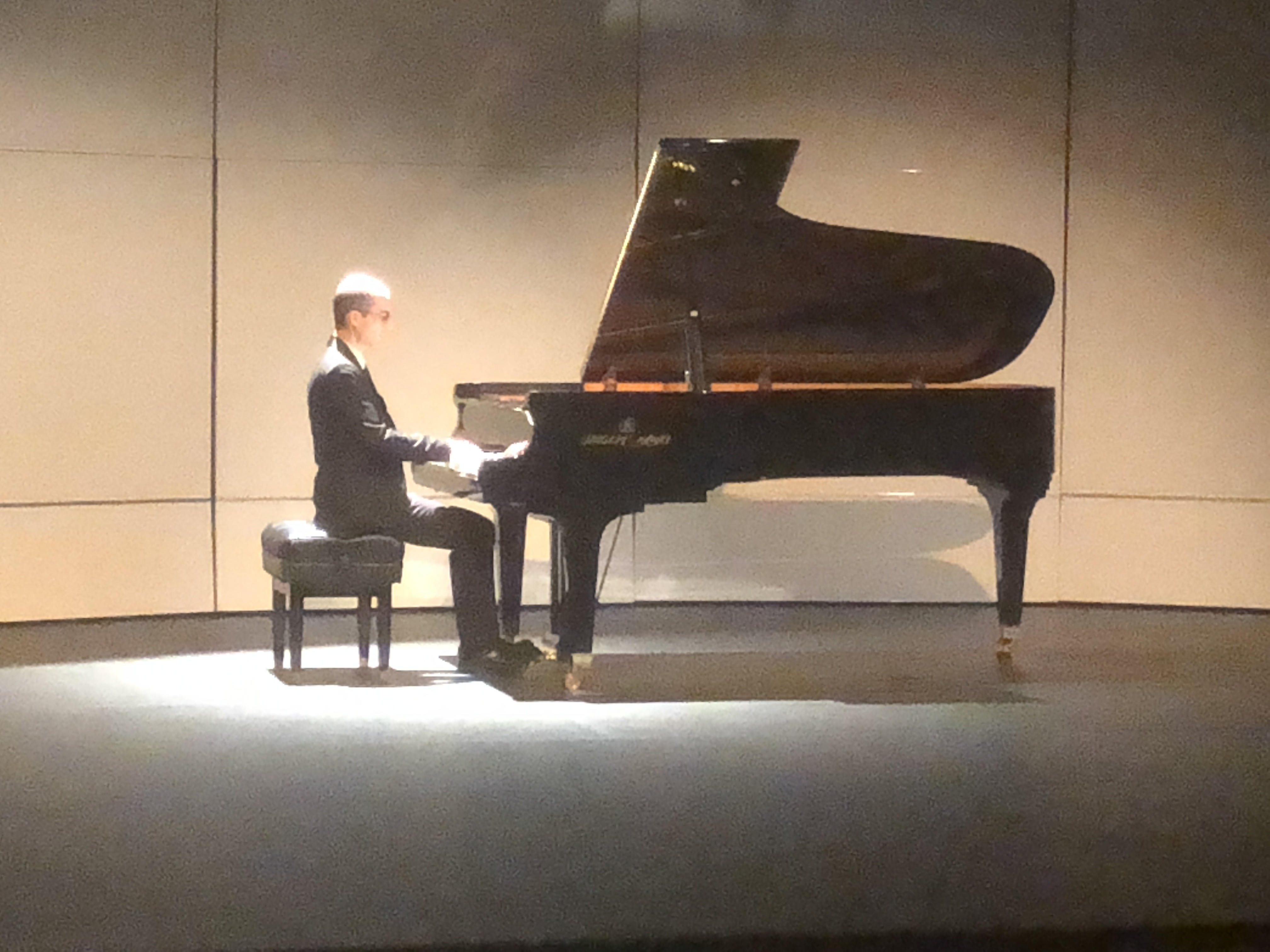
Wednesday, Nov 28, violnist Evgeny Zvonnikov of the Harrington String Qaurtet and WTAMU music faculty, gave, with the help of Vesselin Todorov  on viola and Mila Abassova and Diego Caetano on piano, a bravura performance in the Fine Arts Complex Recital Hall.

Evgeny continues to astound, with the range of his artistry, and that he so generously shares his talent is much appreciated.  And the audience, on this cold November night in cowboy country, was feted to a not-so-cowboy program of Bach, Spohr, Sarasate and Frank.

Bach’s “Chaconne” from “Partita #2” was the program’s nod to the Baroque. Evgeny’s take on the Leipzig Kappelmeister’s creation was double-stopping gypsification. The tone color which emerged was almost viola-like, then sometimes Evgeny produced an extraordinary lyricism with eruptions of  bariolaging.  Not a bad start to the program.

Louis Spohr was a transitional composer from the classical to early Romanticism, whose works fell into obscurity for over a century. Perhaps this is because the composer doesn’t evince an attitude or agenda, the Romantic equivalent of easy listening.  And, hopefully, Evgeny will continue to rehabilitate Spohr’s reputations as he makes use of the composer’s invention: the chinrest.

Pablo de Sarasate had the quirky compositional habit of creating works that would showcase his own superior techniques which he and only a few, like EZ, could perform: try pizzicato with the left and vigorous bowing with the right.  EZ made it look easy! And, though this work was influenced by the zortzico, a Basque dance, at times it pulsed like a street scene in Valencia.

Cesar Frank also had a similar habit to de Sarasate, only his piano works included twelve key chord spans that only his giant maws could encompass.  Yet slight but powerful pianist Diego Caetano met the challenge helping make this performance of  the “Sonata in A major” memorable.

As a teacher, Franck’s persistent admonition was to “modulate, MODULATE!” He would have been pleased by Evgeny’s efforts in this regard, as well as the impressive energy both artists demonstrated in this performance.  The undulation between poignancy and passion was sustained through four different movements, including an Allegro in Sonata form, an Allegreto in Rondo, and a free will improv in the Third.

And, at the end, the audience applauded and kept applauding.  And such a sustained approval for a world-class performance isn’t a one- off here in the Panhandle, but a regular feature in the arts.

So, to the applause of many, we offer the hommage: “Keep Amarillo Artsy!  Keep Austin Weird! Keep Lubbock in the Rear View Mirror!!!!”
December 10, 2018

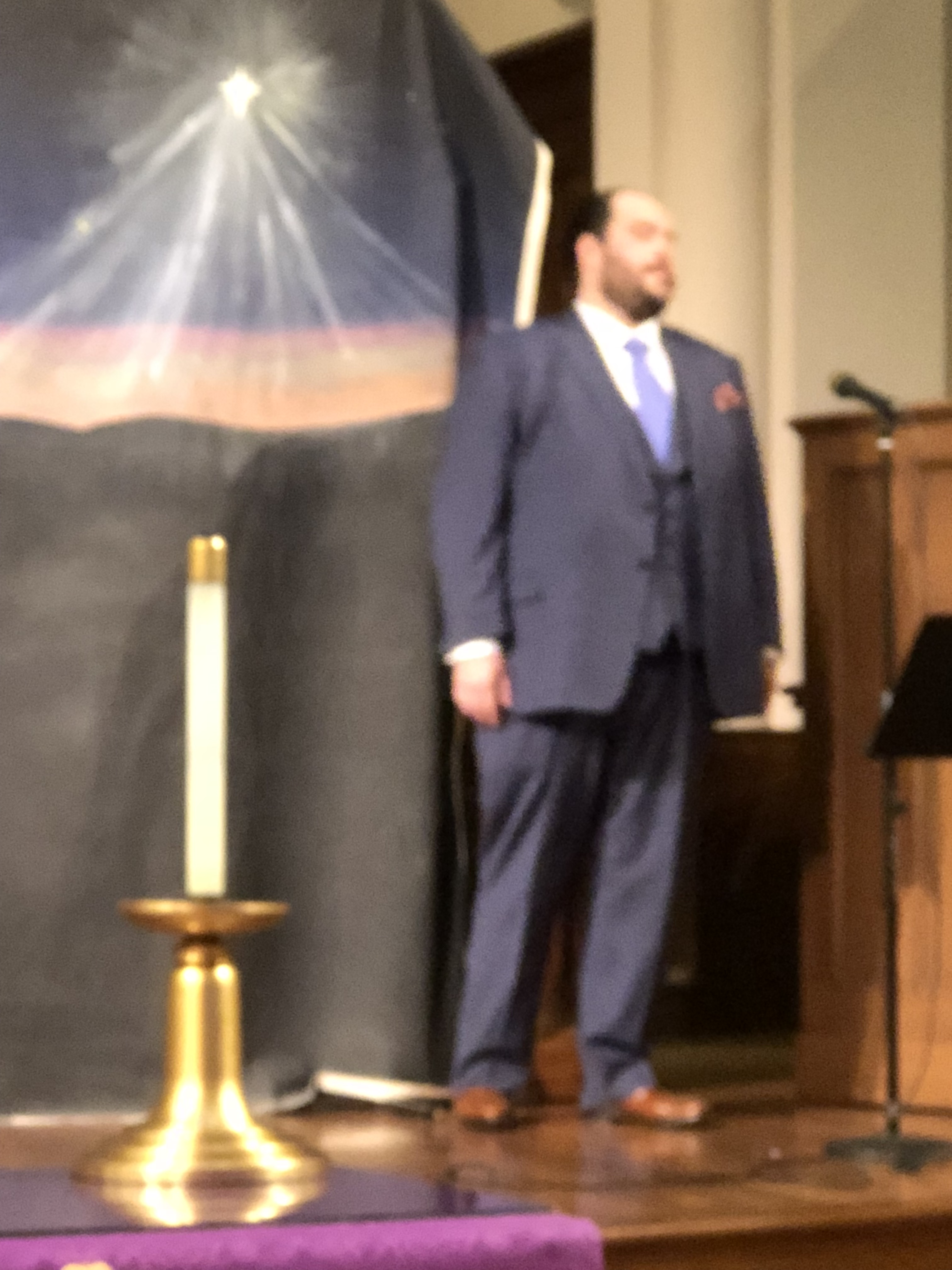
Eric Barry at Amarillo Opera’s Messiah 

December 8, 2018, at Polk Street United Methodist, the first  Messiah sing-along in forever was held, the last remembered event being some three decades ago. Whereas earlier sings had been sponsored by the then Civic Chorus or the generosity of some church, this event was hosted by Amarillo Opera under the new, inspired direction of Mary Jane Johnson. 

Two organists, four directors,  fifteen operatic soloists and some one hundred chorus members (and wanna-be’s) from the community joyfully celebrated Handel’s incomparable holiday message.

No one knew what to expect but a call to roughly-defined sections was quickly followed by the organ prelude.  What ensued was a serendipitous “Wow!”

Tenor Eric Barry opened with the recitative “Comfort Ye My People,” which put me in mind of Luciano Pavarotti at Notre Dame Cathedral in Montreal in 1978.  So, if you missed the Messiah, check out L.P. on Youtube – you’ll get the idea.

The engagement of opera singers for the solos generated an aura of sanctity and sublime artistry which made this occasion impactful.  Those of us in the chorus could only delight in the quality voices of these young professionals and hope that in the four group numbers our attempts to sequence the Handelian runs didn’t register on the Richter scale.

Congratulations MJ! You and Amarillo Opera knocked this one out of the park.  Attendees are already talking about next year, replete with tees! And for this year, anyone not buoyed by the uplift from the Messiah must have Stage 4 Grinchiness.

So, full of the Xmas spirit, we say: “Keep Amarillo Artsy!  Keep Austin Weird! Keep Lubbock in the Rear View Mirror!!!!”
Keep Amarillo Artsy – Dec. 8, 2018

Dr. Agustin Muriago at Amarillo College, Nov. 13, 2018

Tuesday, Nov. 13, Dr. Agustin Muriago from Kansas State performed in Week 11 of the Fall/Winter Amarillo Arts Season and as part of the AC Piano Series.  Dr. Muriago played a full program of Spanish music that, for the fortunate few in attendance, was the gastronomic equivalent of an all-you-can-eat-and-drink buffet of paella and Tempranillo wine.

The first work was composed by Catalonian Federico Mompou, once declared the creative successor to Debussy.  He was influenced by Satie and his ostinato-embellished works are spare but rich. If his “Canzon y Danzas” begins like Dia de los Muertos, it concludes like Mardi Gras.

 Granados, in the six-part “Valses Poeticos,” manages to pull all of the heartstrings.  Or maybe it was Agustin’s happy fingers.  De Falla’s “Danza Espanola, on the other hand, was  a Spanish slam-dunk!  One had no problem hearing the castenets and flamenco guitar from the Shigera Kawai keyboard.

Moritz Moszkowski, obviously Polish, evoked a totally Iberian sound in “Caprice Espagnol,” which was followed by three Habaneras, distinguished by totally different moods and tone by Halffter, Debussy and Chabrier.

Halffter’s flamenco sounded like a major bee swarm, whereas Debussy, inspired by a postcard, at times sounded like an orchish army. Chabrier’s emotive work, on the other hand, delivered on a wide range of dynamics. 

Cuban-born Ernesto Lecuona’s six part “Suite Espanola,” except for the finale of “Malaguena,” remained largely unknown until the 90’s when they enjoyed a Renaissance. Lecuona’s seamless grafting of Gypsy, Moorish and Spanish folk melodies is evident in the three parts Agustin played: Cordoba; Andalucia; Gitanerias.

Any Spanish program would be incomplete without a work by Isaac Albeniz. The composer was inspired by a culturally diverse section of Granada and portrays the vibrant night life in the streets, with generous octavian pounding. 

This was truly a magnificent performance and it is unlikely that an Amarillo audience will anytime soon hear such a program of Spanish music.  Who’d have thunk that here in cowboy country we would have heard it in the first place?

Our gratitude and thanks to Dr. Agustin Muriago for his matchless artistry and to Dr. Diego Caetano for arranging the program.  Don’t know where he finds these incredible pianists,  but we’re the better for his efforts.

So we can say with glissandos: “Keep Amarillo Artsy!  Keep Austin Weird” “Keep Lubbock in the Rear View Mirror!!!”

Keep Amarillo Artsy 12/06/18

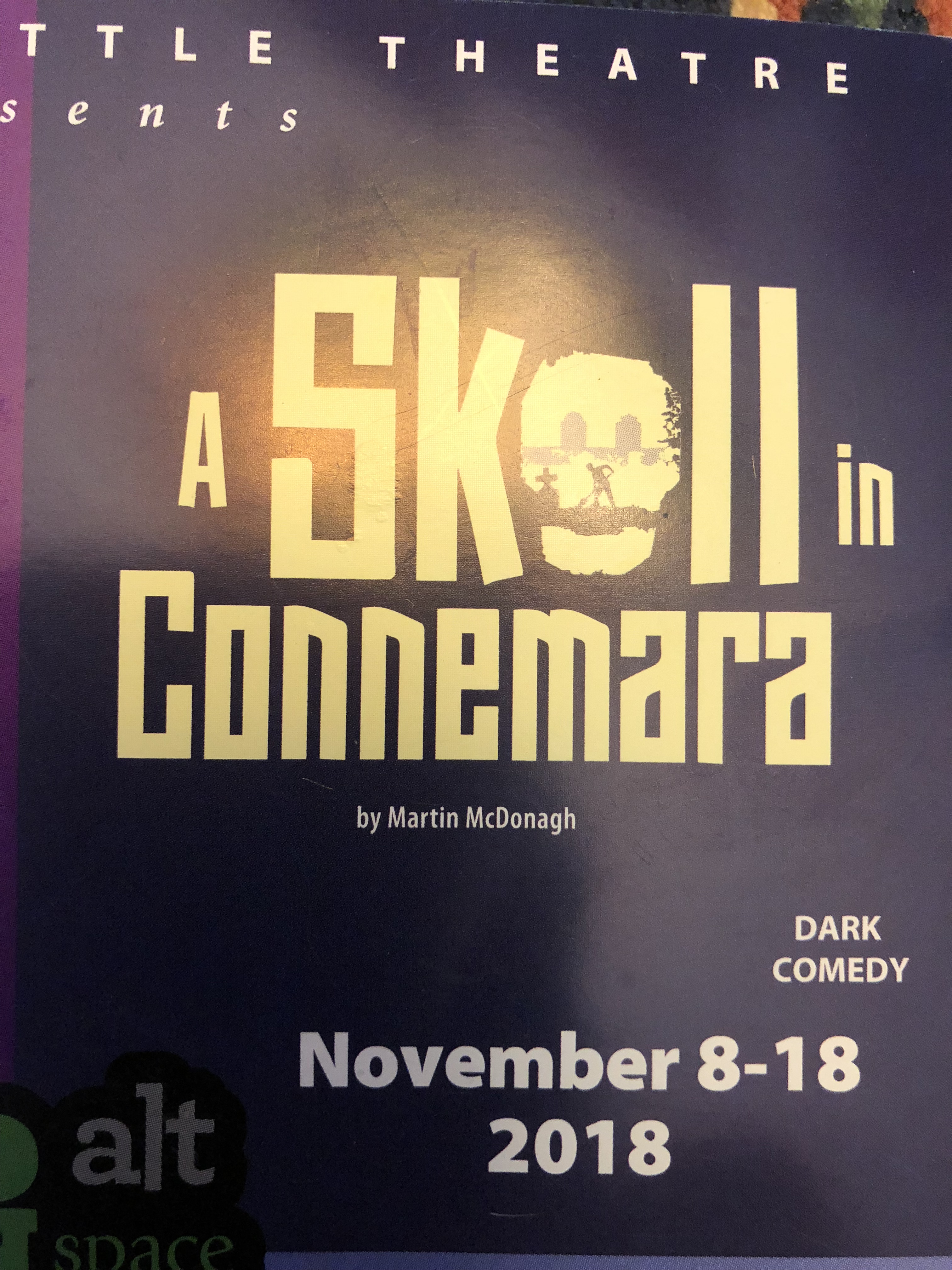
Well I know I’m a wee bit behind, but Week 11 (Nov 10 – 16) of the Fall/Winter Amarillo Arts Season began with a Skull in Connemara staged at  ALT’s Adventure Space.  This one-act play of dramatic darkness by Martin McDonagh has the not exclusively Irish moral of “Don’t be a’diggin up the past. 

A former felon, exhonerated for murdering his wife, is now on contract with the parrish priest to exhume long-interred bodies to make room for new arrivals.  Thus he connects with the remains of his late wife.  Still stung by lingering suspicion, the whole play pivots on whether he’ll man up to smash her skull, whose pulverizing is standard protocol to free up new ground.

To “help” him are three friends, whose Blarneyfied rationale is poteen-fueled. In fact,  poteen, the potent brew distilled from potatoes, plays such a prominent role that it should be mentioned in the program as a character.

Nothing interloculatory  is ever straight forward in Ireland.  The most simple statement elicits cosmological commentary.  The real gift of the play for the audience is the gab.  The actors appropriated the lilt of the Irish brogue, including the undulating rhythm, and made it real.  Such a way that these folk in the Panhandle can carry on; just like they’re right out of County Cork.

Naturally the play is also a study in character.  Shannon Mashburn plays a sort of maternal parasite who at base is just in need of companionship and free hooch.  Patrick Burns is Mark Dowd, whose internal demons are in plain view and Jeff Jarnagin plays the frustrated constable whose ambitions rise  above his disinterest in disinterment. 

Kayden Burns plays Mairtin Hanlon who intially reveals himself as shiftless and self-indulgent, but morphs into the character conscience of the play. All so very Irish.

Hammers and shovels are unlikely props, but this play  called for grave digging and skull-smashing. Thus a film of dust coated the audience, a number of whom had to dodge flying cranial bits.  Well, it did add a touch of the real, it did!

The obvious theme was textured, layered and nuanced.  McDonagh’s dark work was about the outside and inside: the darkness in the world and in the soul, a concepts near and dear to the hearts of the Irish. 

In this most -unlike-the-Emerald-Isle place,  Irish pathos was celebrated by talented thespians directed astutely by Alan Shankles whose end product was worthy of the Abbey Theatre in Dublin.  

So fill up m’glass with poteen and Slainte to all!

But remember:  Keep Amarillo Artsy!  Keep Austin Weird!  Keep Lubbock in the Rear View Mirror!!!!

Keep Amarillo Artsy

This blog is dedicted to the anomalous cultural phenomenon of the arts in the Amarillo area.  A phenomenon because in terms of cities of comparable size nationally, only Santa Fe has greater, and it is much greater, production in the arts.

But Santa Fe is crazy liberal creative, and the arts naturally fit.  Amarillo, well, deep state red will do – CONSERVATIVE – the grand inhibitor of the creative, applies everywhere, except here. The arts here are a true anomaly, planet-wise.

And I plan to explore this cultural contradiction, in all of its creative varigations, in Keep Amarillo Artsy.

One location, more than any other: St. Mary’s Catholic Church in nearby Umbarger, represents  this conundrum in all of its aspects, and so deserves mention in this inaugural blog.

How many places on the planet stand as testimony to warring peoples making common cause to create beauty that is both enduring and inspiring? This church, in tiny Umbarger, Tx is one of the few!

Six months after VE day, come 3500 Italian POW’s remained at Camp 31 near Hereford.  Among these soldiers, who maintained their fascist allegiance, were a number of artists.  In Nov. ’45 these artists held a public exhibition.  One of those vsiting was the parrish priest from Umbarger, who asked the camp commandant if any of these artists could decorate his dull, gray barn of a church.

Eight prisoners volunteered, originally to get out of camp and eat home-cooked farm meals.  Six weeks later, on the eve of repatriation, they completed the “Cathedral of the Plains.”

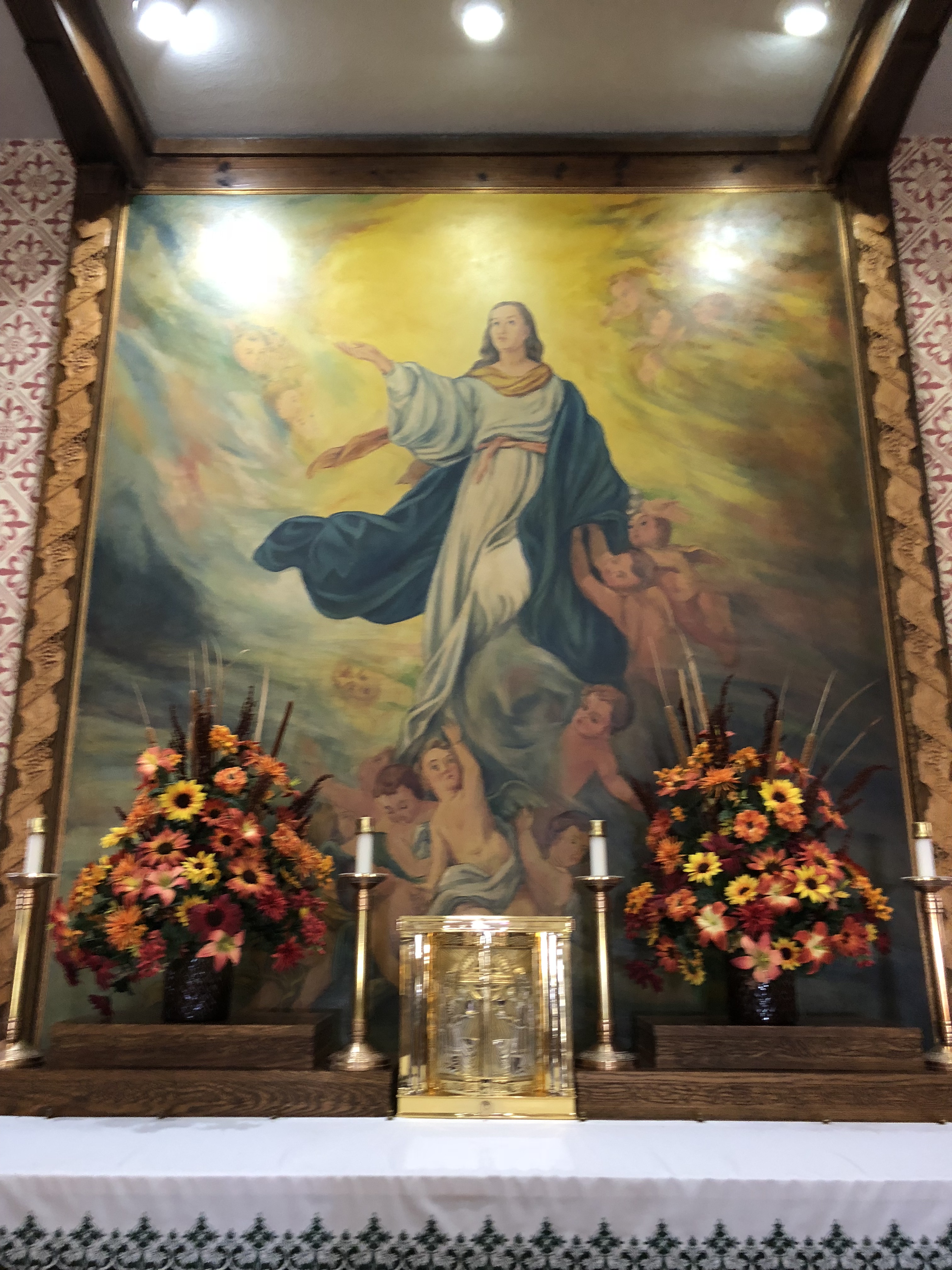
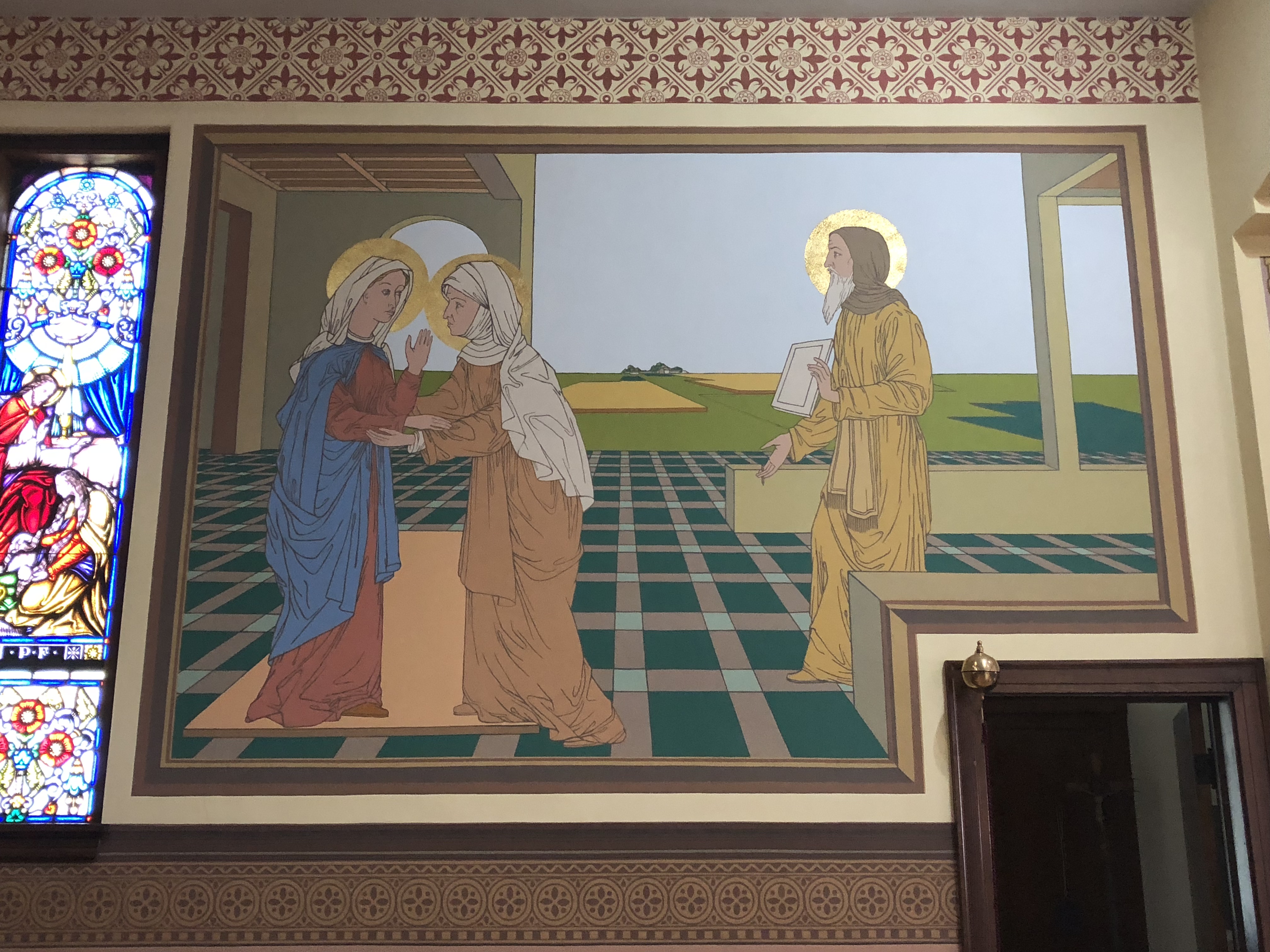
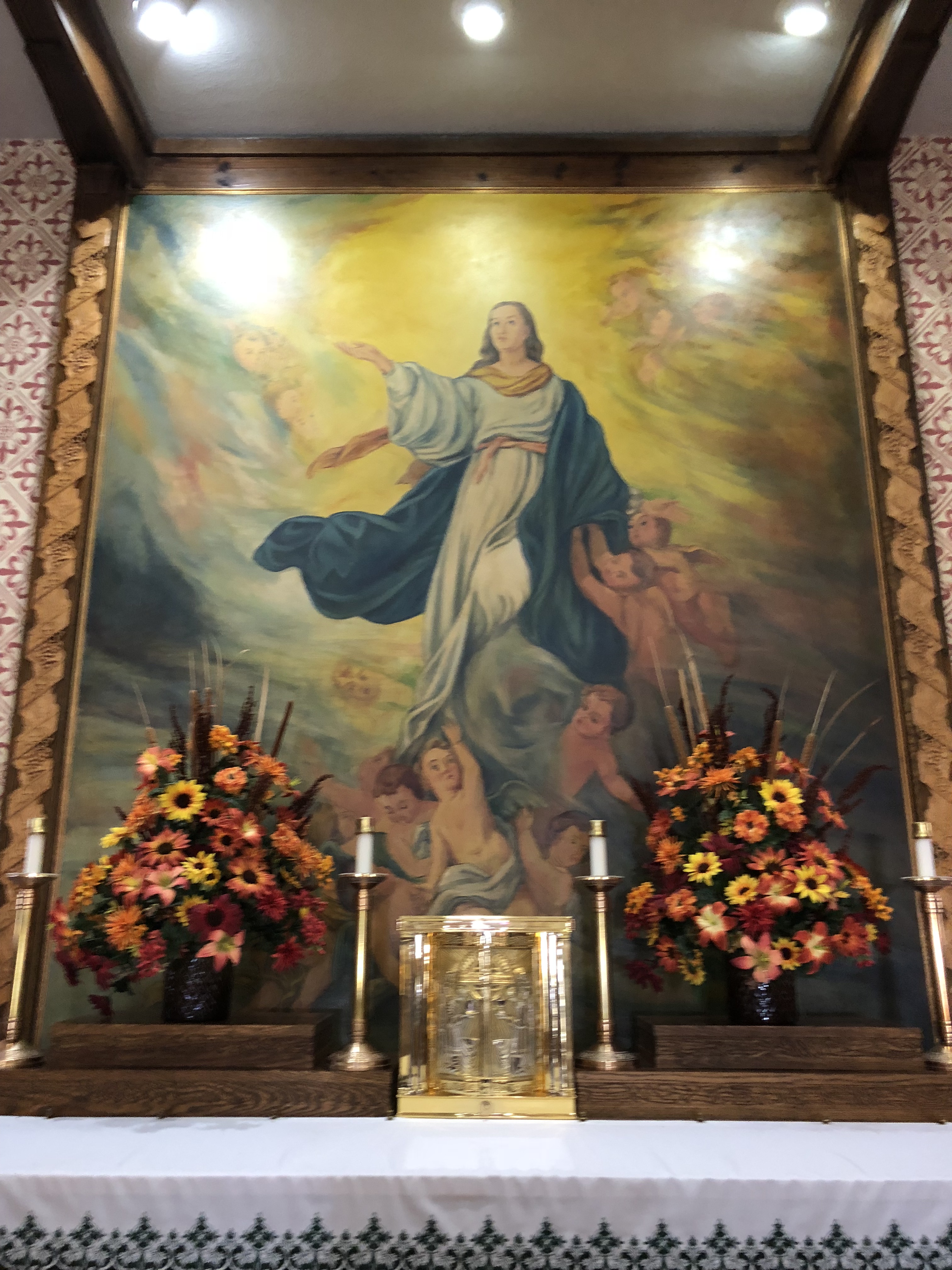
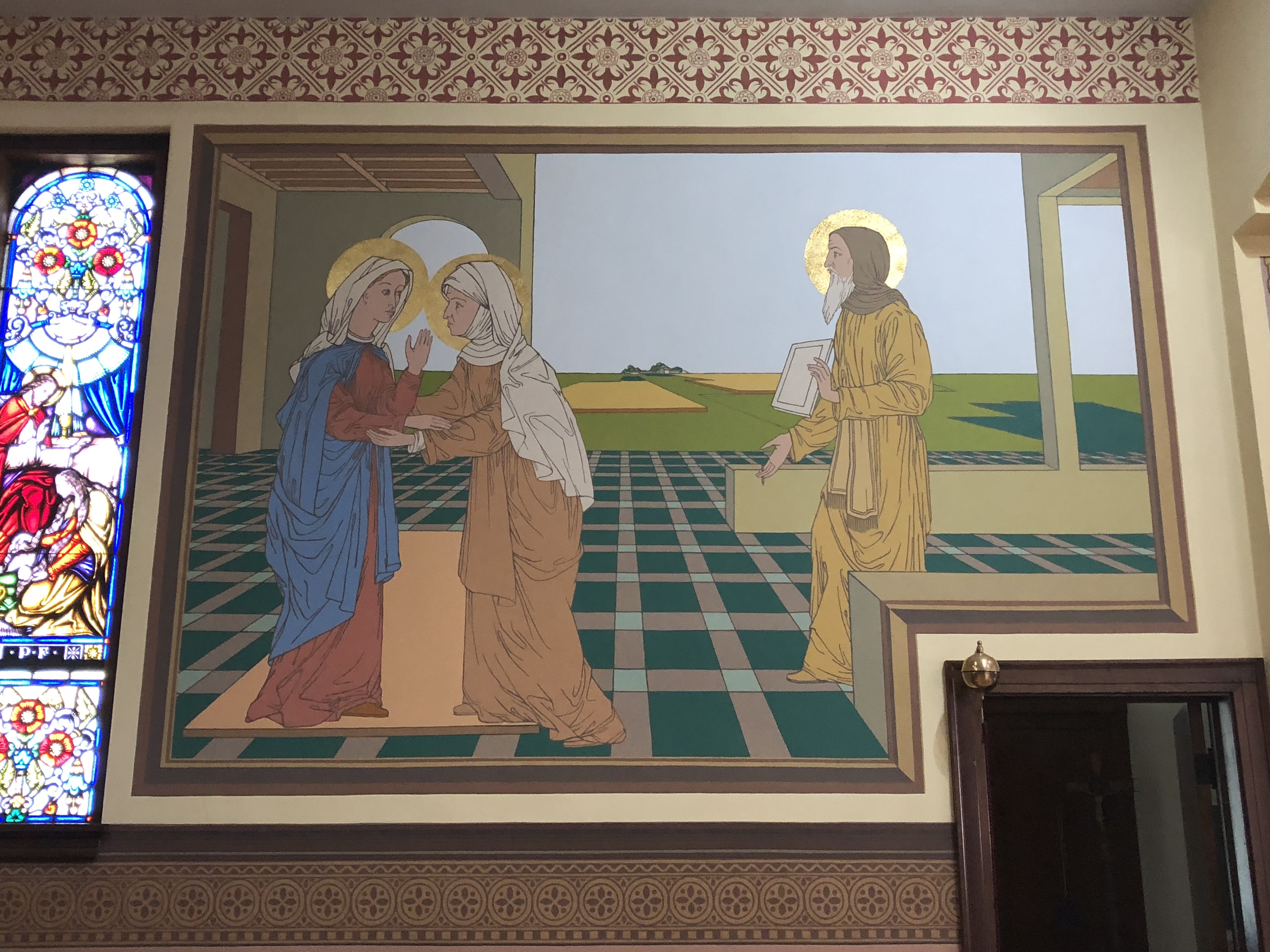
The large Assumption of the Virgin puts one in mind of Titian while the Visitation and the Annunciation bear a definite Fra Angelico bias, except that the landscapes show High Plains wheatfields. The carved panel on the front of the altar is a meticulously-carved rendering of DaVinci’s Last Supper while the Italiante-assembled stained-glass windows cast a kaleidoscope of colors reminiscent of Chartres.

Every tenet of reason militates against the existence of St. Mary’s: time – war; place – Nowhere, Tx; most of all human nature.  Former national enemies rose above their politics, trusted one another, and created a work of transcendent beauty! 

St. Mary’s also stands as metaphor for all of the amazing art of the Amarillo area, whose very existence is counter-intuitive.  My happy task, in the collaborative spirit of St. Mary’s, is to acquaint my readers with the paradox and the endless permutations of Panhandle art. 

In this journey of cultural enlightenment, our mantra will be: “Keep Amarillo Artsy!  Keep Austin Weird! Keep Lubbock in the Rear View Mirror!!!!”
The Assumption of the Virgin, the Annunciation, Nave of St. Mary’s Catholic Church, Umbarger