Sept. 9, 2019 – Amarillo Master Chorale, 40 Yr Reunion Concert

Dr. Nathaniel Fryml
Conducting
Amarillo Master Chorale
August 24, 2019

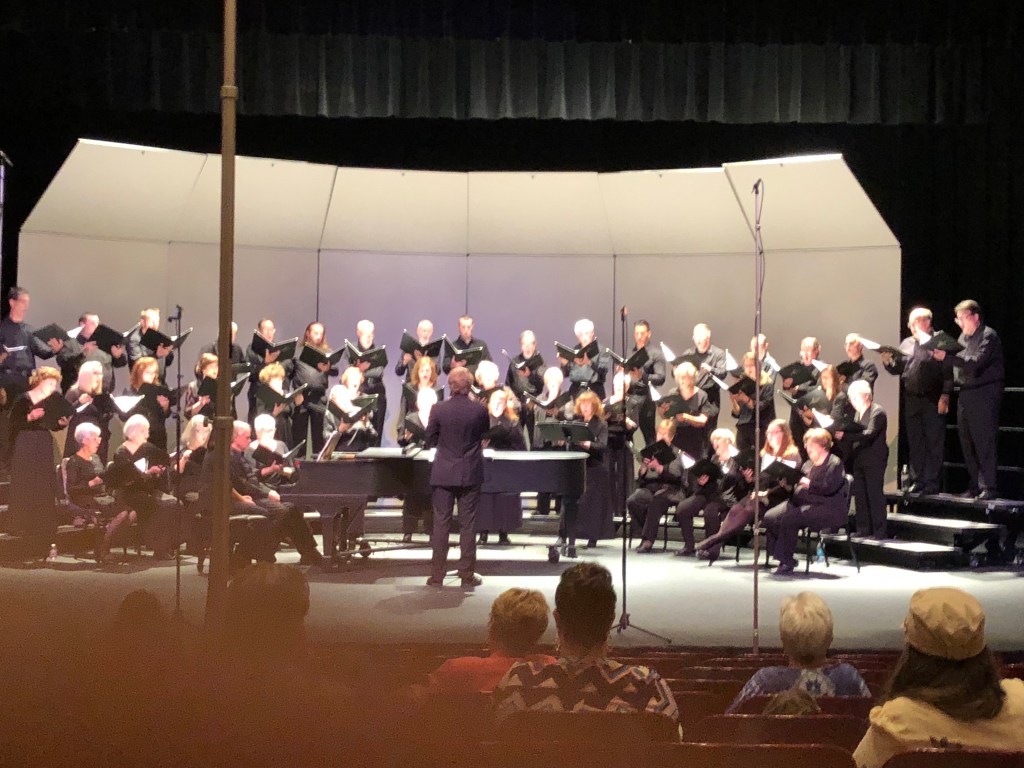
The Amarillo Master Chorale christened the 2019/2020 concert season with a fortieth anniversary reunion concert held at the Amarillo College Concert Hall Theater August 24th. The conductors were the four men who have served in that capacity for the various iterations of the chorale over the past four decades.

The choristers demonstrated their talent by performing eight challenging numbers, including one in Latin, with only one day’s practice.

The AMC opened with Jane Marshall’s I Will Extol Thee from Psalms 145 and under the direction of Dr. Nathaniel Fryml, current artistic director. This piece has a soprano opening followed by a layering of tenors. The word “exuberance” defines this work, which ends with an incredible “Amen.”

Dr. Fryml would later conduct The Road Home by Stephen Paulus, which has a wordless opening and strikes this listener as a stream of consciousness bespeaking longing and hope, a sense amplified by the soprano of Cathy Weber.

Dr. George Biffle, founder of the then Civic Chorus, led the ensemble in two different works, the first Hark, I Hear the Harps Eternal, a product of Alice Parker, longtime primary arranger for the Robert Shaw Chorale.

This work pulsed: the downbeat of each 3/4 triad was emphasized like a vocal percussion section. This is the second work of Alice Parker done by the AMC within the last year, and, like the first, connected the audience to America’s past, to the Second Great Awakening, when the country’s westward surge was seen as proof of divine providence.

Dr. Biffle’s second work with the Chorale, was John Rutter’s For the Beauty of the Earth. This piece was just a lovely, lilting prayer of thanksgiving, in contrast to the assertiveness of the previous song.
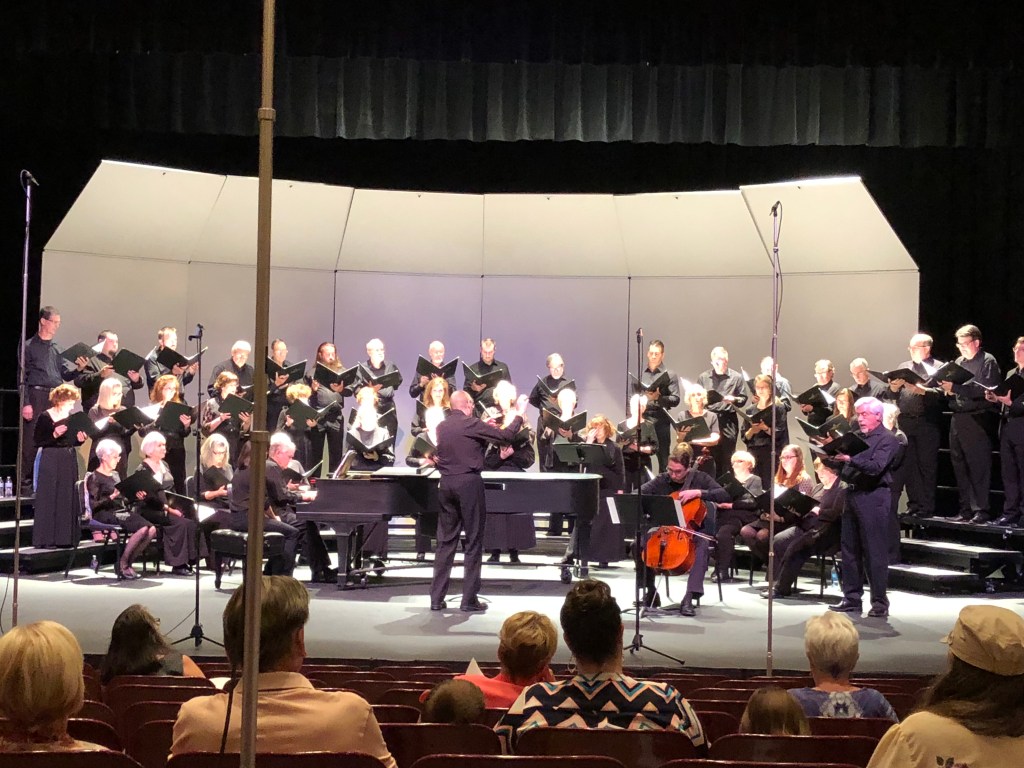
Dr. Richard Nance
Lee Kindle – baritone
Russell Steadman cello
Dr. Noel-Paul Laur piano

Dr. Richard Nance, artistic director of the Civic Chorus from 1985 – 1992 and now at Pacific Lutheran University, directed the Gloria from Haydn’s Paukenmesse, or, as it is sometimes called, Mass in the Time of War.

This work was written in 1796 during Austria’s war with revolutionary France. The virtual absence of martial overtones has led some critics to maintain that the piece is really anti-war in sentiment.

Regardless, this work is pure Poppa Haydn, textbook classical and grandiloquent. A protracted baritone solo by Lee Kindle was answered by the chorus and soprano Paige Brown. The cello of Russell Steadman complimented the piano of Dr. Noel-Paul Laur. who accompanied the Master Chorale in all of the numbers this evening.

It was under Richard Nance’s leadership that the Civic Chorus, teaming with the WTAMU University Chorale and the Amarillo Symphony, performed Beethoven’s Ninth. Thirty years would elapse before the Ninth would again grace an Amarillo audience.
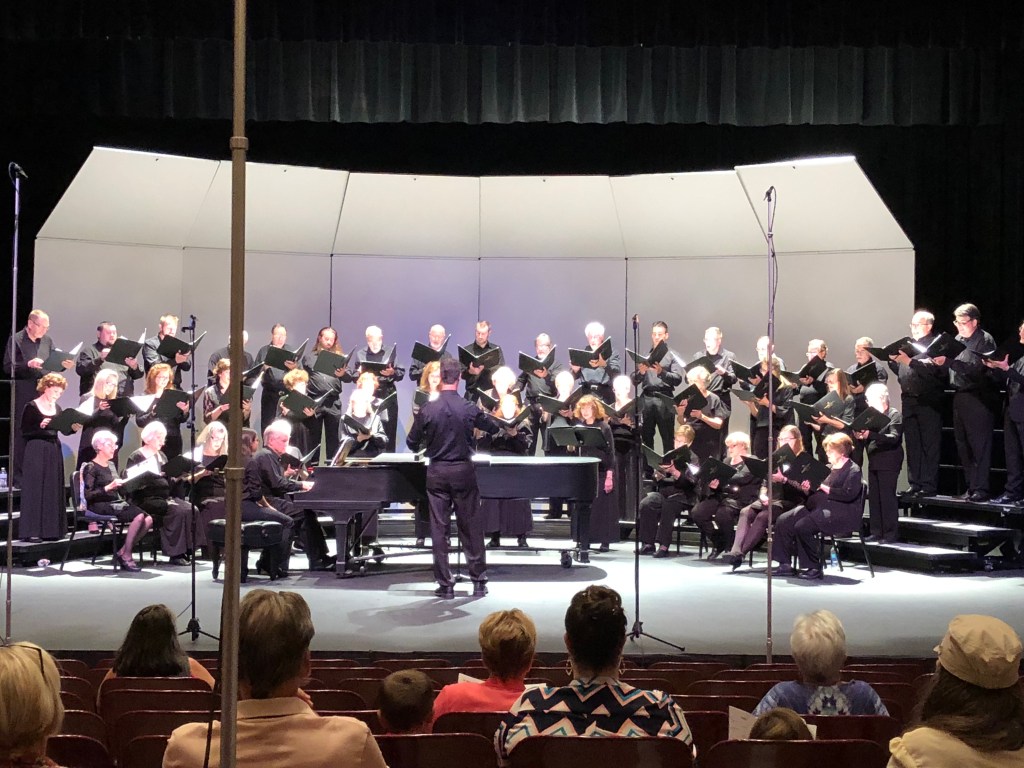
Dr. Steven Weber

Dr. Steven Weber, presently choral director at Wayland Baptist University, was artistic director of the Amarillo Master Chorale for twenty-four years, conducted the singers in two numbers.

The first, Where Your Bare Foot Walks, is based on a Coleman Bark’s translation of Rumi and very benedictive in nature. The song becomes a gaggle of co-existing parts, like the tongues of men, which coalesce to swell in unison.

The second work, Let Peace Then Still the Strife by Mack Wilberg, as the title suggests, is a beautiful prayer for peace. Opening with a first tenor lead, the lyricism becomes strongly hymnal.

Dr. Dale Roller, who as chairman of the music department at Amarillo College, oversaw AC’s affiliation with the Civic Chorus, directed the final number, The Lord Bless You and Keep You by Peter C. Lutkin, with music provided in the program.

Dr. Fryml invited all former singers with the group to join the AMC on stage, and perhaps ten emerged from the audience. On a personal note, after thirty years, my bass sounded pretty good. Of course, I was standing next to Steven Weber.

This concert fulfilled a noble vision while celebrating the impact of all those who have contributed their time and talent these last four decades.

Amarillo can be justly proud of its Meistersingers, whose music ranks as professional quality. These glorious sounds only enhance Amarillo’s artistic aura, enabling us to say as the 2019/2020 arts season is upon us: “Keep Amarillo Artsy! Keep Austin Weird! Keep Lubbock in the Rear View Mirror!!!

Sept. 3, 2019: Current AMOA Exhibitions

The goal of artists is merely to alter the perceptions of mere mortals, in order to see the world in a different way. Two exhibitions at the Amarillo Museum of Art certainly justify this mandate.

“Cut Up, Cut Out” consists of some fifty collagial – note the play on words-international artists whose works were originally shown at the Lesher Center for the Arts in Walnut Creek, California. And, though most of the works can be called collage, others dazzle with negative space.

The second, “The Panhandle Collects Anonymously,” is composed of quality contemporary pieces, of local but undesignated ownership. And it ain’t cowboy art!

A sampling of “Cut Up, Cut Out” reveals the range of artistry in this exhibition.

Mark Wagner
Hello From Tokyo

Mark Wagner uses currency, namely dollar bills, since money exists as a primary form of self-expression. By expressing all human activity and achievement in purely monetary terms, the artist raised real questions about societal values. But he did emphasize, in his art talk, that he breaks no laws in this use of this medium.

Amy Oates
All the People I Encounter Each Day

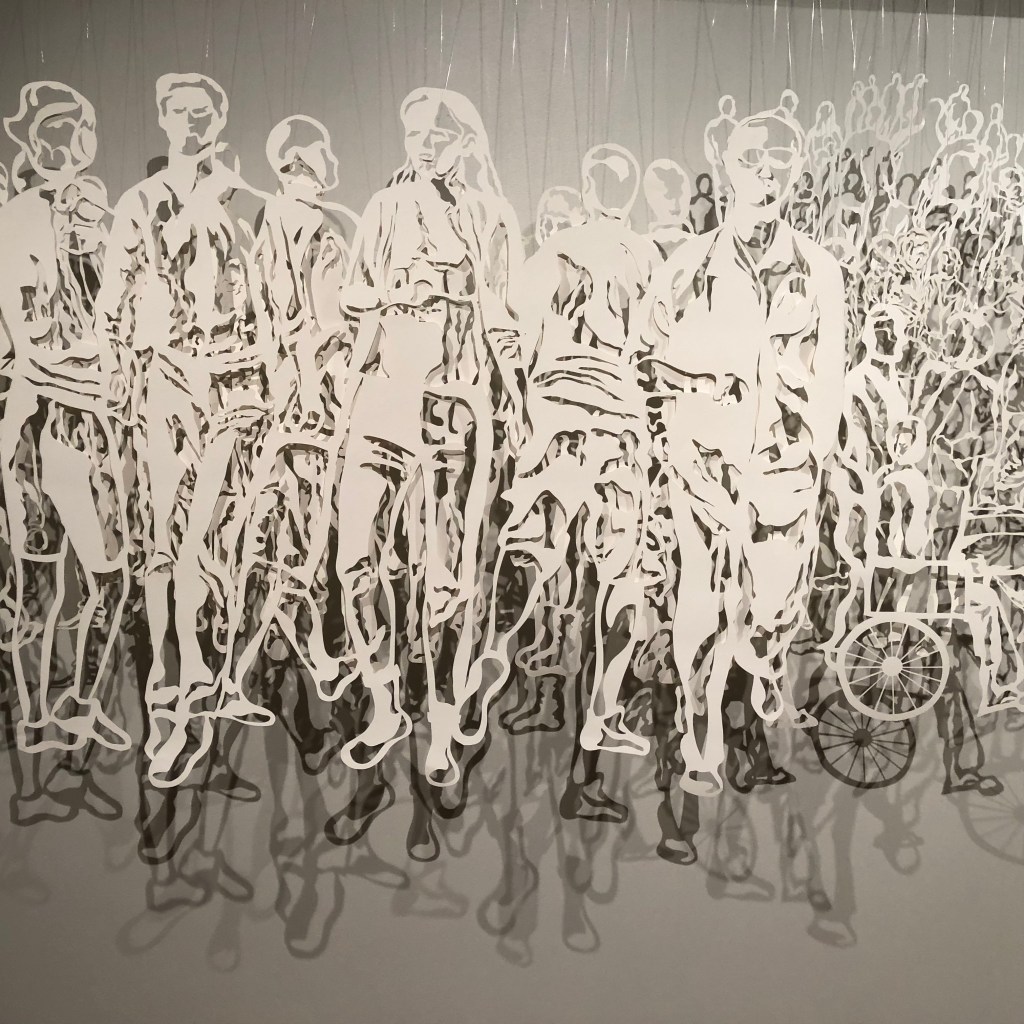
Amy Oates uses a true cut-out collage presentation of a large number of people, engaged in a variety of pursuits. We see their shape, their form, their suggestion of being, but do we really see them?

Rogan Brown
“Small Kernal”

Rogan Brown, from Nimes, France, is influenced by the microscopic world and cytology. His Small Kernal, 2013 suggests a mitotically-frozen filamentous bacterium in staggering detail.

Michael Buscemi
Heart of the Son

Similarly, Michael Buscemi’s Heart of the Son erupts like an explosion of dendrites from a neurological core. Again, the detail is amazing.

Carl Lane
Sweet Spill

One of the exhibition’s iconic works is Carl Lane’s Sweet Spill, a thirty-gallon oil drum cut in delicate and intricate filigree, demonstrating that perhaps the banal and the blighted can ultimately become a thing of beauty.

Mounir Fatmi

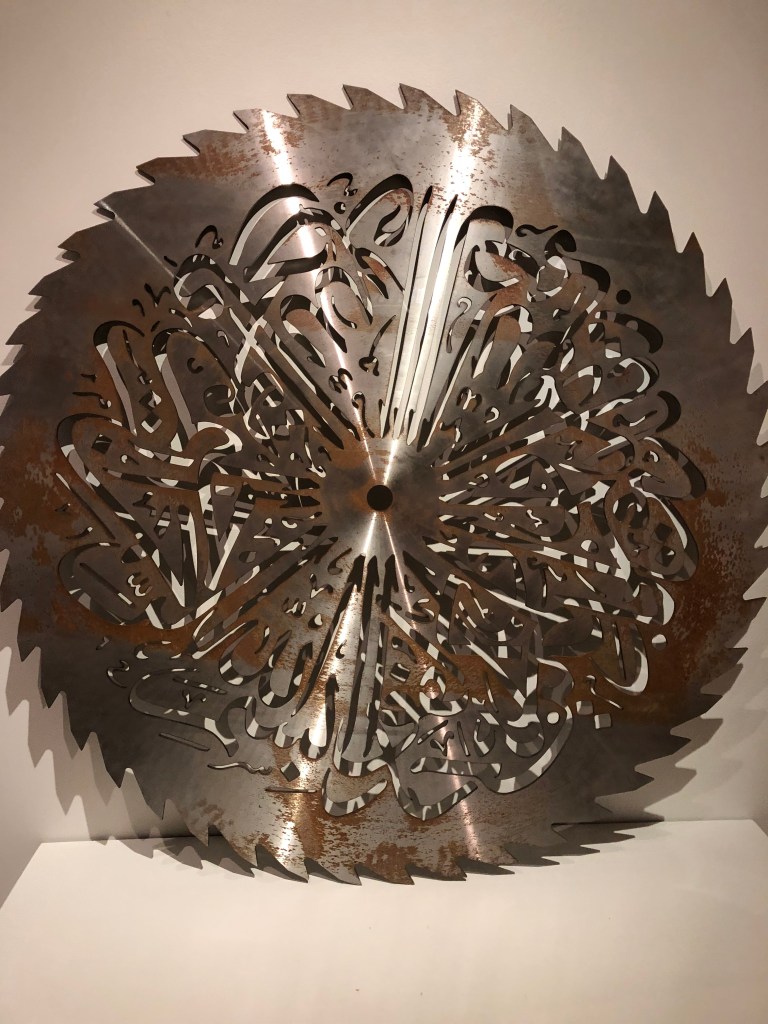
Another impact work is Mounir Fatmi’s calligraphic cut-out of a giant table saw with passages from the Qu’ran, perhaps implying that the scriptures of all faiths possess the provocative dualism of inspiration and destruction.

Gallery View
The Panhandle Collects Anonymously

The other exhibition at AMOA, The Panhandle Collects Anonymously, is similarly impressive as it demonstrates that there are those, here on the plains, whoever they may be, who are au courant in the acquisition of incredible art.

Teun Hocks
Untitled

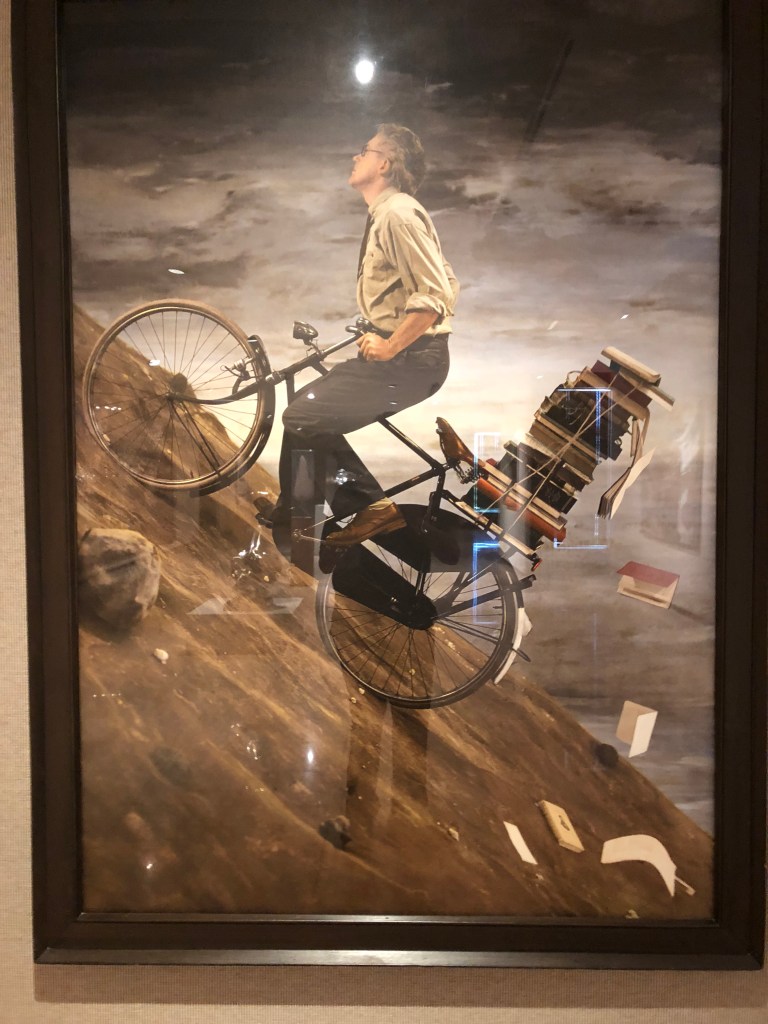
Two works are notable, the first an untitled work by Hollander Teun Hocks, which to me, portrays the Sisyphean challenge of college and especially graduate school.

Joel Morrison
Untitled

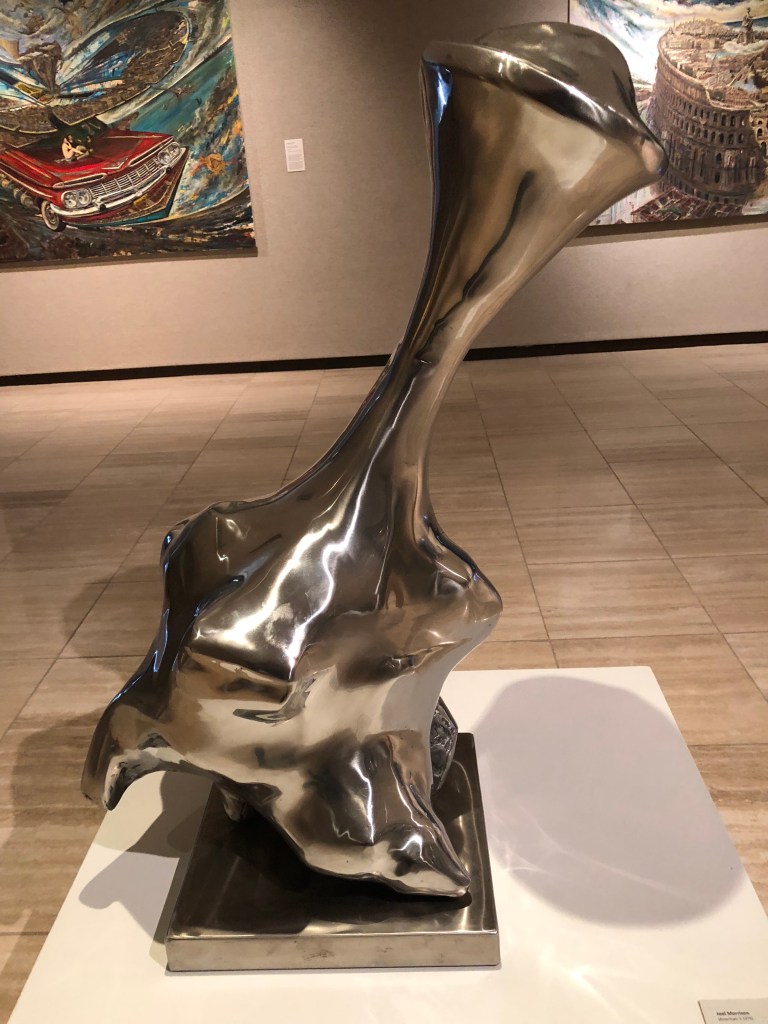
American Joel Morrison filled bags with various objects, then managed to stack them together over which he cast a mold. The result is, well, interesting. I just wonder in what part of their house the mysterious owner chooses to showcase this work.

We appreciate the generosity of these people, whoever they are, and that of the Bedford Gallery for Cut Up, Cut Out. Because of AMOA’s dedication to mounting engaging and provocative exhibitions, like these, we can assert, with confidence, “Keep Amarillo Artsy! Keep Austin Weird! Keep Lubbock in the Rear View Mirror!!!”

August 29, 2019: ALTAS- “The Underpants”

ALT launched its 2019/20 season with the production of The Underpants at the Adventure Space. This comedy is the Steve Martin adaptation of the German play by Carl Sternheim from 1910.

The play’s plot, contrived even for a farce, centers around the consequences arising from publicly-dropped drawers. Louise, played by Macy Owen, thinks nothing of the incident until problems of perception proliferate.

In an era where hemlines reached the floor, just the suggestion of forbidden fruit catalyzed a chain reaction of libidinous misconceptions and misadventures involving the whole cast.

Originally written in the heyday of Freud, The Underpants is laced with sexual overtones and double entendres played against serious social issues making the play often seem like a mash-up between Abbott and Costello meeting Tennessee Williams.

The dramatis personae played their characters with a punch and verve that kept the audience engaged. Owens, the ingenue, morphs from clueless to a worldly-wise hausfrau finally owning up to her own desires and needs.

Richie Garza, as husband Theo, is the ocd, narcissistic and similarly clueless bureaucrat whose penchant for worst-case scenario makes mountains out of molehills and drives the whole play. His pretensions to perfect public deportment crash and burn when he comes on to his neighbor Gertrude.

Shannon Mashburn plays this goodhearted but lusty nosy neighbor from hell with all this part demands and then some.

Director Cy Scoggins, making his ALT debut, acknowledged that the biggest challenge in this production, as in any comedy, was timing, and much of the effort of both director and cast concerned the clock. It worked, as the production produced laughs galore.

The laughs largely stem from Steve Martin’s rewrite, and often hide darker issues. For instance, the hypochondriacal fetishist Cohen, played superbly by Jonathon Mobley, keeps belaboring the point that it is Kohen, with a K, thus desemiticizing the name.

Similarly, Sternheim excoriates the pretentious hypocrisy of German bourgeois morality which masked the strident reactionary militarism which would explode in WWI.

And the most elevated, vaunted elements of German society, the nobility embodied in the Kaiser (Brent McFarland) and the educated elite in the character of Klinglehoff (Michael Westmoreland) reveal the same common ground of primal urges and failings.

Since Aristophanes, dramatic comedy has been a two-edged sword. And, with The Underpants, alarm bells sound. If the Germans had listened to their artists and playwrights, the great catastrophes of the twentieth century could have been avoided.

The thanks of our community goes to Amarillo Little Theatre for productions that are multifaceted and layered. Yet, quality theatre is only one of the manifold arts abounding here in Cowboy Country.

This is why we say, at the beginning of this arts season, “Break a Leg, and Keep Amarillo Artsy, Keep Austin Weird, and Keep Lubbock in the Rear View Mirror!”

August 22, 2019: Market Street Wine Club Tasting

Market Street Wine Club
Summer Wine Tasting
Ashmore Inn
August 8, 2019

What do viticulture, and the high culture of the fine arts have in common? Well, fine wine, of course!

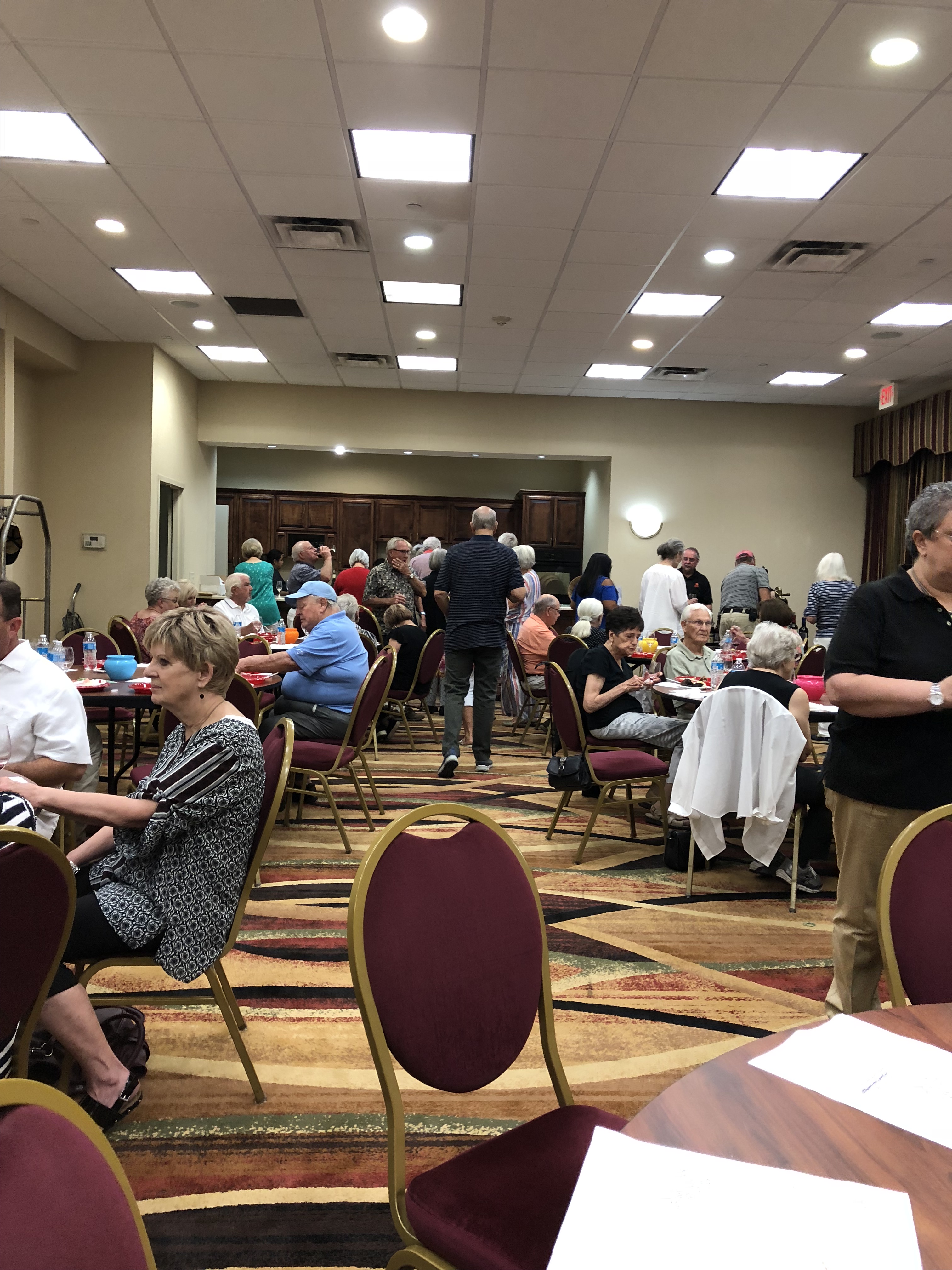
That commonality was celebrated in Oenophilia Gone Wild, otherwise known as the Market Street Wine Club, in its monthly-themed gathering, this time at Amarillo’s Ashmore Inn.

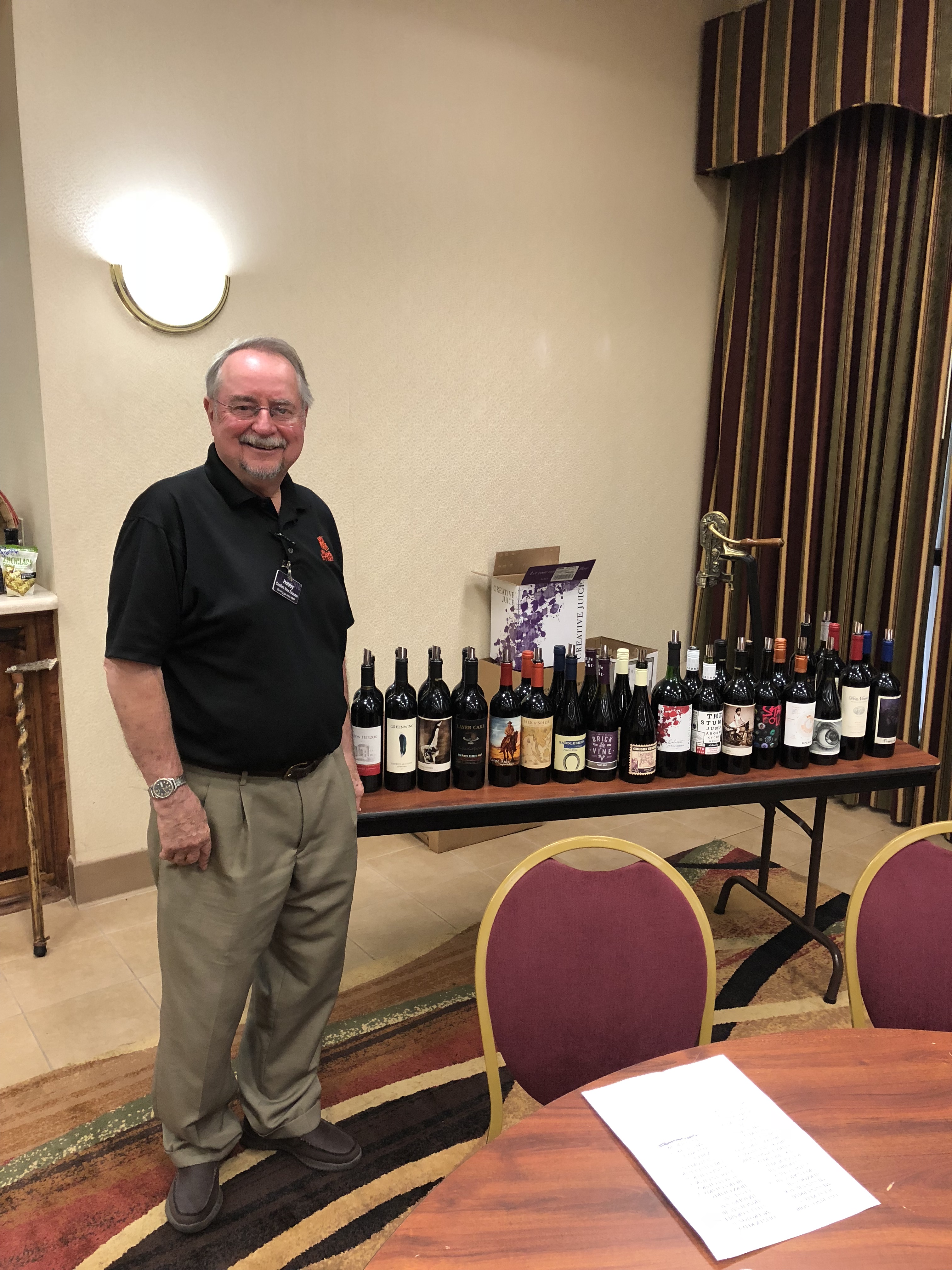
Founded in 2000 by Hobby Kuehnast, United Market Street’s Wine Steward and Certified Wine Educator, the wine club now has a closed membership, all associates zealously guarding their privilege of regularly getting together to sample the wines and tastes of the season as much as Hispanic grandmothers guard their mole recipes.

Hobby Kuehnast
Market Street Wine Steward
Certified Wine Educator
The New Reds

This particular seasonal observance, as if one needs an excuse to drink decent wine, was the New Mexico Green Chili harvest, which also provided an opportunity to sample some of the forty new mid-range wines: emphasis on “sample some.”

The non-dessert items featured, surprise, green chilis! There was green chili meatloaf, green chili mashed potatoes, and dinner salad with green chili dressing, which was quite good. This being the southwest, green chilis are the ubiquitous condiment, and demonstrate congenial pairing with both reds and whites.

The New Whites
Also
More Summer Wines

The new arrivals included labels from California, Texas and Argentina, a few of which were noted before the palette became benumbed to discernment. The menu slanted my choices to the reds: perhaps I’ve arrived at a level of wine snobbery, but white wine with chili-spiced meatloaf inspired a gag reflex.

A Mendoza Malbec, Don Nican, has a bite up front but then mellows over the course. Similarly, a Cabernet Sauvignon from Kinker Winery in Paso Robles has a nuanced announcement, but then travels very well.

There was no ambiguity in Messina Black, a meritage from Messina Hof Winery in Bryan, Texas. This was just solid over the whole run, standing well against the entree.

The biggest surprise for me was the Layer Cake Bourbon Barrel Cab. I’ve always pejoratively aligned Layer Cake with its nominally-similar Cupcake: now I’ll have to revise (only slightly) any prejudice, admitting that bourbon makes a good seasoning agent for an oaken cask red varietal.

Alas, the liability of the kid-in-the-candy store syndrome for wine aficionados: so many wines, so little time, and there’s getting home.

Amarillo, in the middle of the Texas High Plains, might be the last place to expect a legitimate gathering of oenophiles. But, thanks to Hobby, United Market Street and its management, this association of connoisseurs is approaching its third decade.

And, thanks to generous and dedicated patronage, the appreciation for fine wine, like the fine arts, thrives up here in Cowboy Country. That’s why we toast, in either red or white, the upcoming arts season and say “Keep Amarillo Artsy! Keep Austin Weird! Keep Lubbock in the Rear View Mirror!!!!”

August 15, 2019: Desert Chorale, Santa Fe

Desert Chorale
St. Francis Basilica
Santa Fe, NM
Aug 9, 2019

Nothing like a weekend trip to Santa Fe switches on the cultural power pack in anticipation of the opening of the Amarillo arts season.

The Desert Chorale’s final concert of the season was held Friday, Aug 9 at the St. Francis Basilica. This ensemble, arguably the world’s finest, is led by Joshua Habermann, also director of the Dallas Symphony Chorus.

The program was entitled Luminosity: The Nature of Celestial Light, and never have I encountered such a combination of the profound, transcendent and exuberant in one program!

Four works enabled this celestial flight: two by living composers, then one each by Bach and Mendelssohn. Accessories to the voices and instrumentation were Los Santos on a high iconostasis blessing the sound by their imprimatur, and the vault of the basilica, which enfolded the listener in the aural ecstasy of the magnum mysterium.

Luminosity, by James Whitbourn, and commissioned for the Westminster
Choir College, is a series of seven tone poems drawn from the mystics of three faiths, all reflecting affirmation of the divine light in creation.

Sometimes the choristers projected an edgy dissonance, which crescendoed into a crash of the tam tam. Add to this, a Carnatic violist, Kimberly Fredenburgh, who played the southern Indian style with the sensual abandon of a gypsy. Then with the drone of the tempura serving as a continuo, this Whitbourn piece offered a sonic smorgasbord for the spirit.

In Luminosity’s afterglow, the Desert Chorale performed Bach’s Der Giest hilft unsrer Schwachheit auf, a funeral dirge turned celebration of life.

The entire work has antiphonal potential as it is scored for two choirs, which in the first movement compliment and the second coalesce in a cascade of Baroque counterpoint while the third embraces a joyous Lutheran chorale structure.

Los Santos didn’t seem to mind. After all, Omnia ad maiorem Dei gloriam!

In the musical realm of Ave Maria’s, the versions of Schubert and Gonoud normally come to mind. Mendelssohn’s work, as performed by the Desert Chorale, needs inclusion in that short list.

A solo tenor opens and reappears throughout this lyrical piece. In fact, in contrast to the other Aves, heavenly lyricism overrides hagiography, thus omitting the assertion of any religious biases, and lifting the listener upwards of wings of art.

The final work on the program, Santiago, is the stunning finale to the four movement Path of Miracles by British composer Joby Talbot.

This section of the composition musically portrays the end of the medieval pilgrimage route from western Germany to its terminus at Santiago de Compostella. Taking up to two years to traverse, this Camino de Santiago became a dominant social feature of the Late Middle Ages.

The dictates of popular piety held that viewing the sacred skull of the apostle imparted lifelong absolution, with the faithful returning home blessed and blessing all.

The music of Santiago captures the heart of the believer as they are transformed, and the Desert Chorale transmitted that passion to the audience.

But the work poses multiple challenges to both conductor and performers. Sung in up to sixteen parts in multiple languages with divergent rhythms might sound like the recipe for choral glossolalia, but Maestro Habermann and the finest singers in the world climbed these mountains to deliver the full impact of the work.

This included, for the audience, empathy with the rebirth and walk in newness of life experienced by the pilgrim.

And, finally, the chorale exited in four lines through the nave continually offering the benediction “God help us now and evermore,” replete with choreographed dispensation of blessings, and diminuendo dominant until they had disappeared and the great vault was silent and still.

Then the audience rose as one, and, turning towards the narthex, offered a thunderous ovation, many pausing to wipe away tears.

Beethoven said that music can raise men to the divine. And, through the voices of the Desert Chorale, if we, in the audience on August 9, could not see the same celestial light as the mystics, saints and pilgrims, we could feel their transcendent joy in the divine.

The proximity of Santa Fe and the Desert Chorale only amplifies the amazing art already in Amarillo. That’s why we can say with certitude: “Keep Amarillo Artsy! Keep Austin Weird! Keep Lubbock in the Rear View Mirror!!!!”

Aug. 8, 2019: “Chalk It Up!” AC and PBS

“Chalk It Up!”
Oeschger Mall
Amarillo College
July 27, 2019

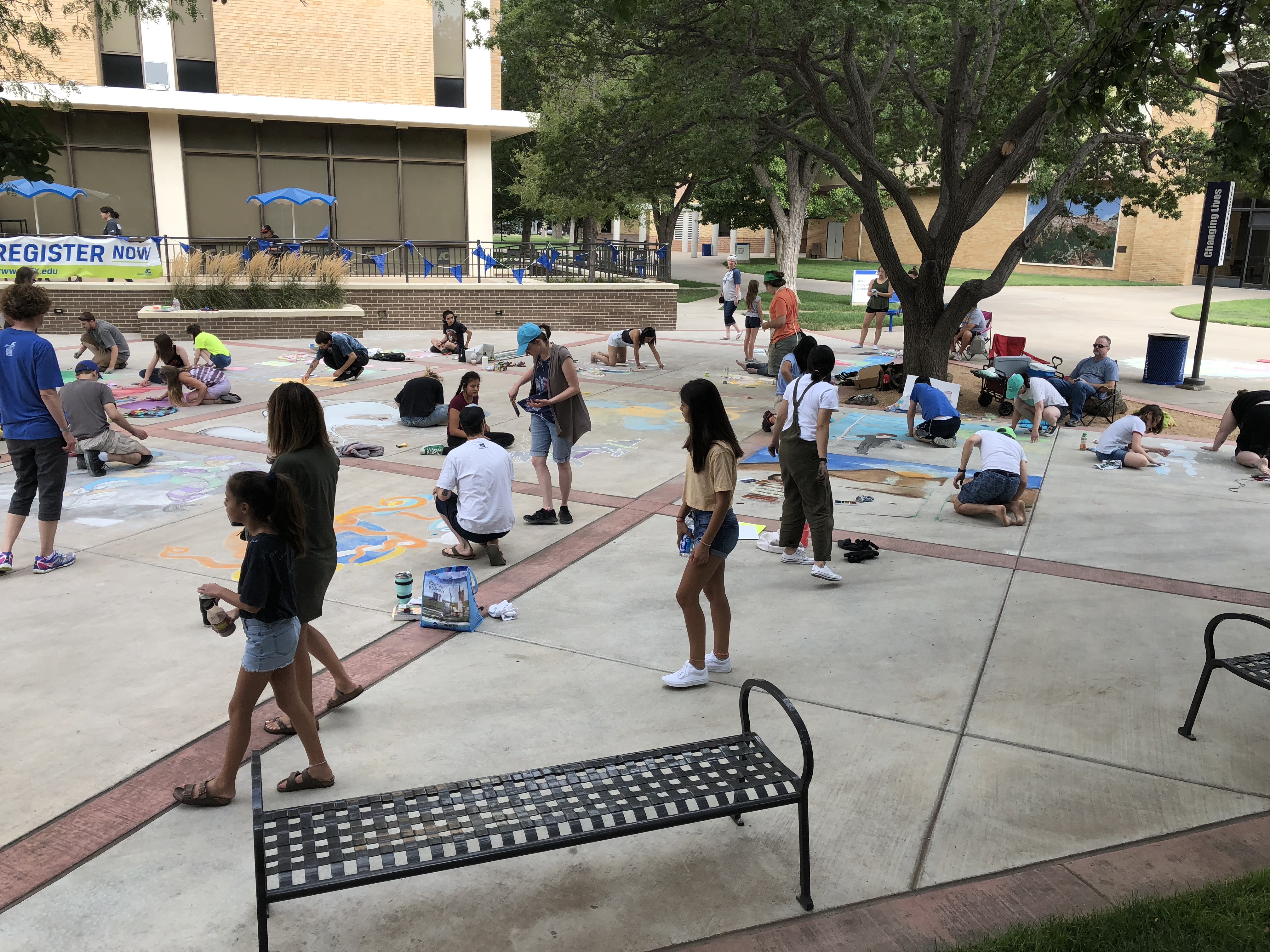
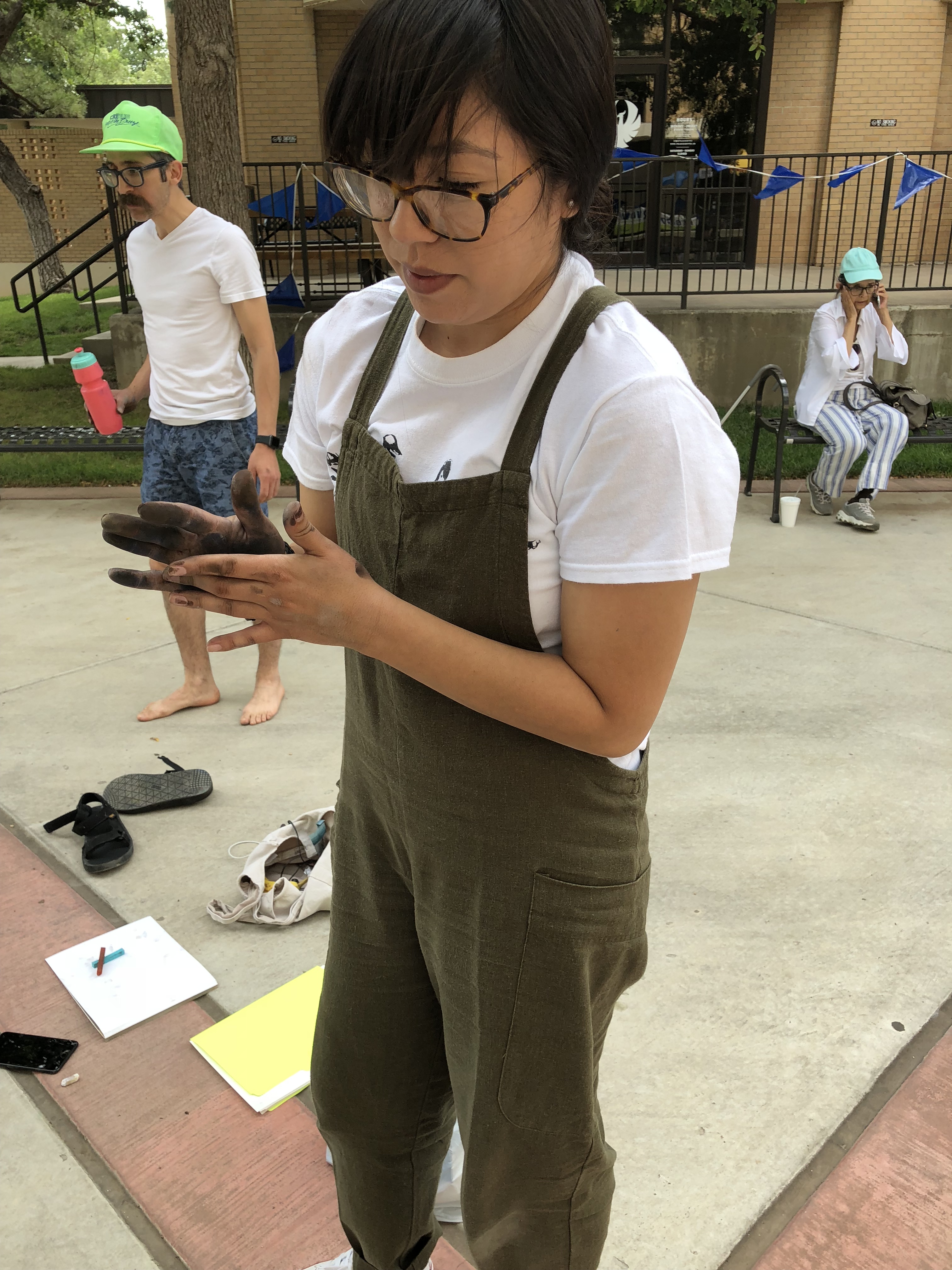
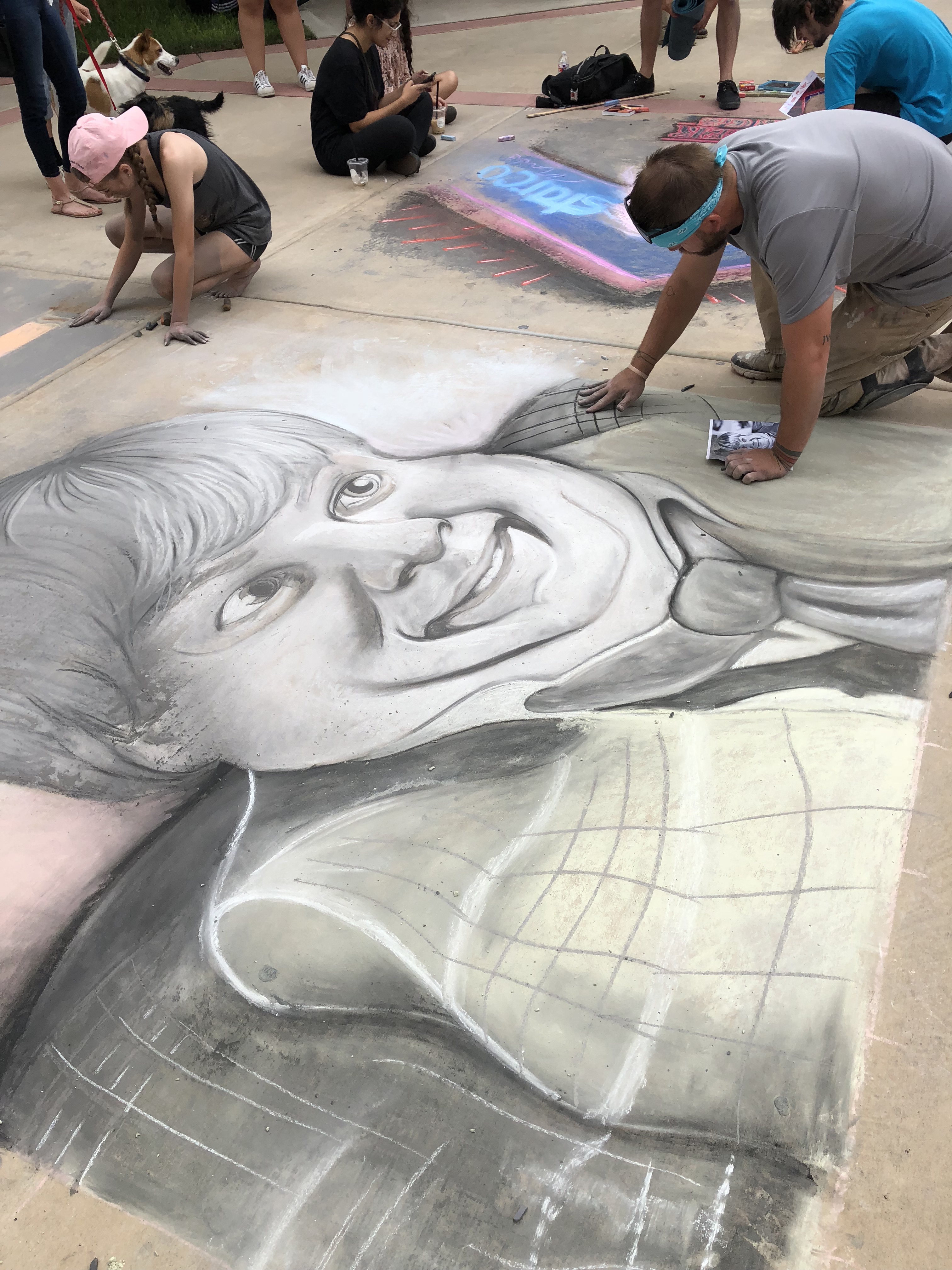
Saturday, July 27, AC, in collaboration with PBS, hosted the third annual “Chalk It Up!” with a full slate of some forty artists competing for hefty purses to see who could most colorfully fill an 8′ X 8′ square on the Oeschger Family Mall.

The works speak for themselves: imaginative and creative with colorful imagery that in many cases passed the bounds of the incredible, especially since it was nearly all done sans knee pads. A sampling of works and artist’s comments follow.

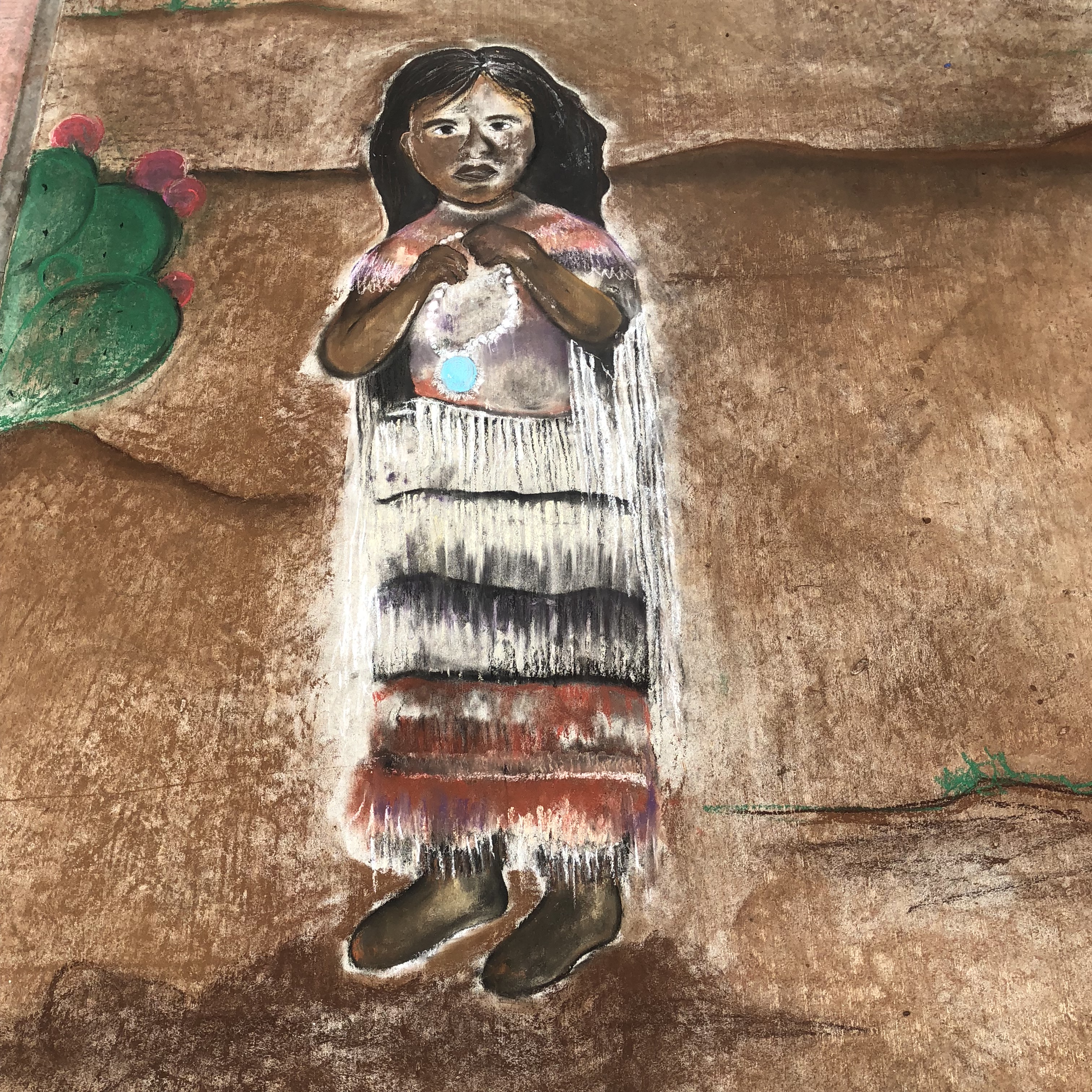
Product of Judith Lara
Judith Lara

Judith Lara stated that chalk to her feels very alive and the blending of the colors creates a sort of magic. The image, which is an EveryChild immigrant, reminds her of her home in Arizona.

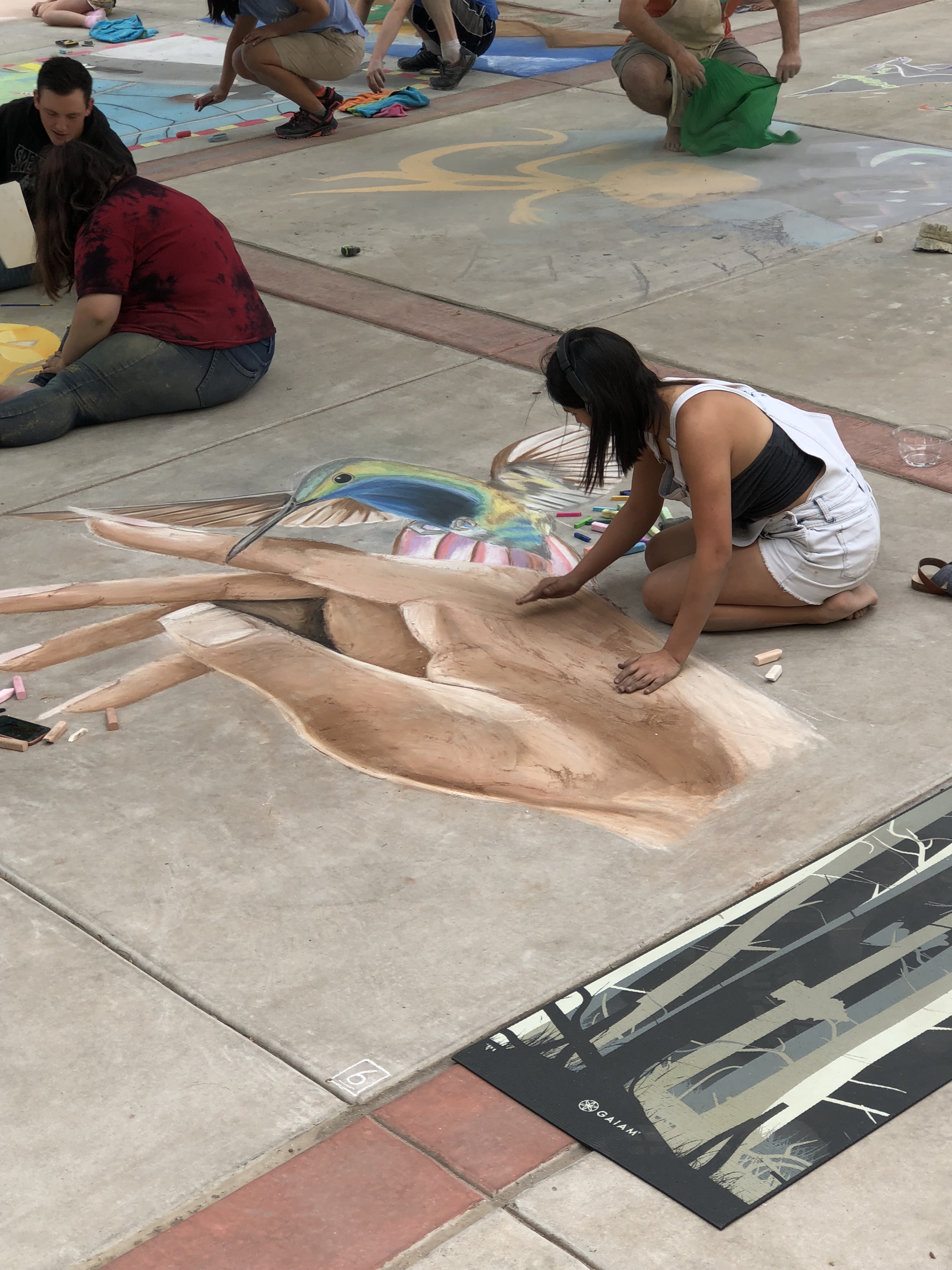
Another childhood memory was evoked by Ronda Finney, a senior at River Road High School and state level UIL art competitor, who said that hummingbirds were a major part of her life and associated with her grandmother.

Ronda Finney

Her work expresses the bird’s fragile beauty against an oversized human hand: the beauty of nature against the heavy-handed treatment by humanity. Youth has a message for all mankind, that needs to be heard.

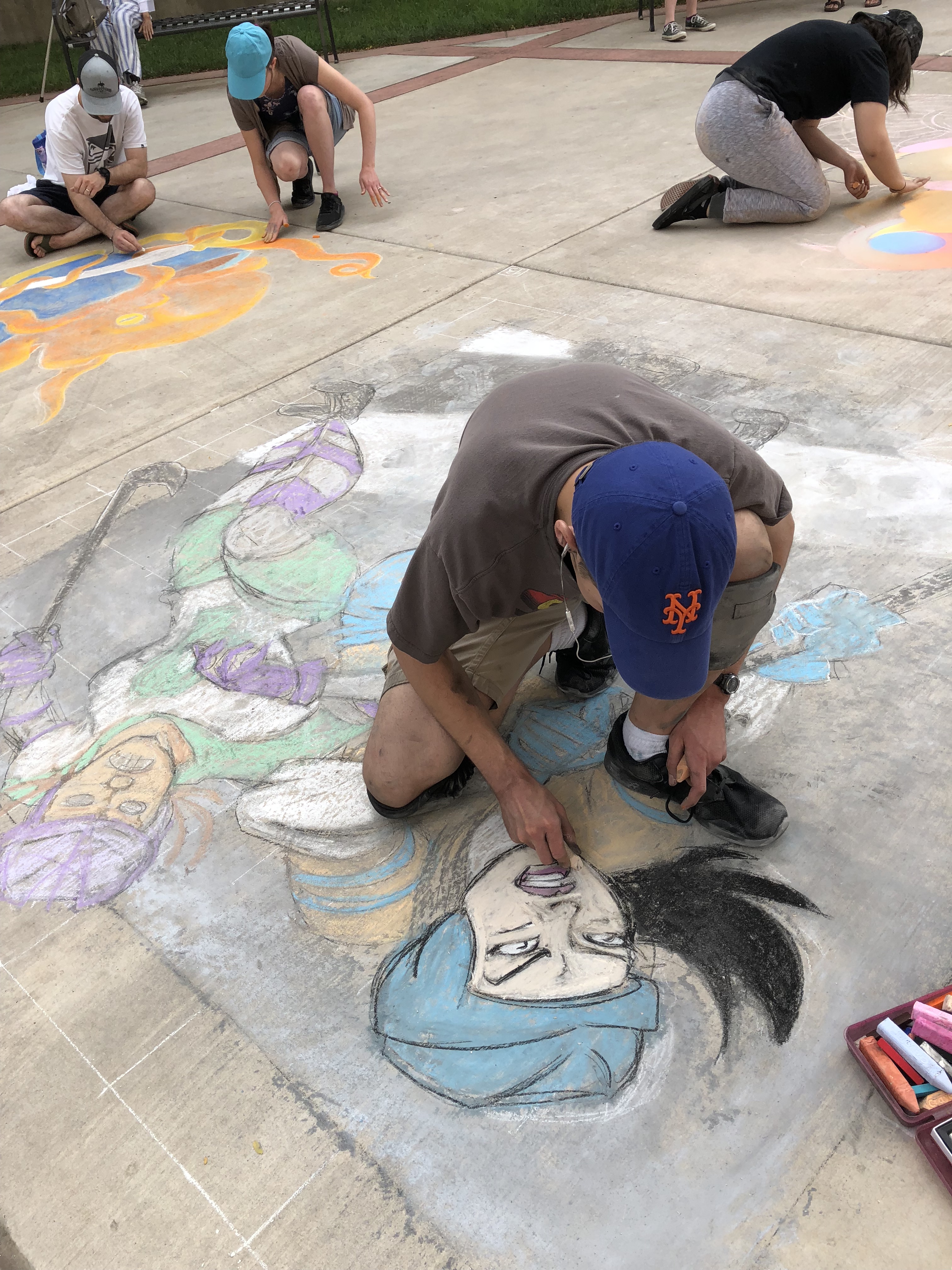
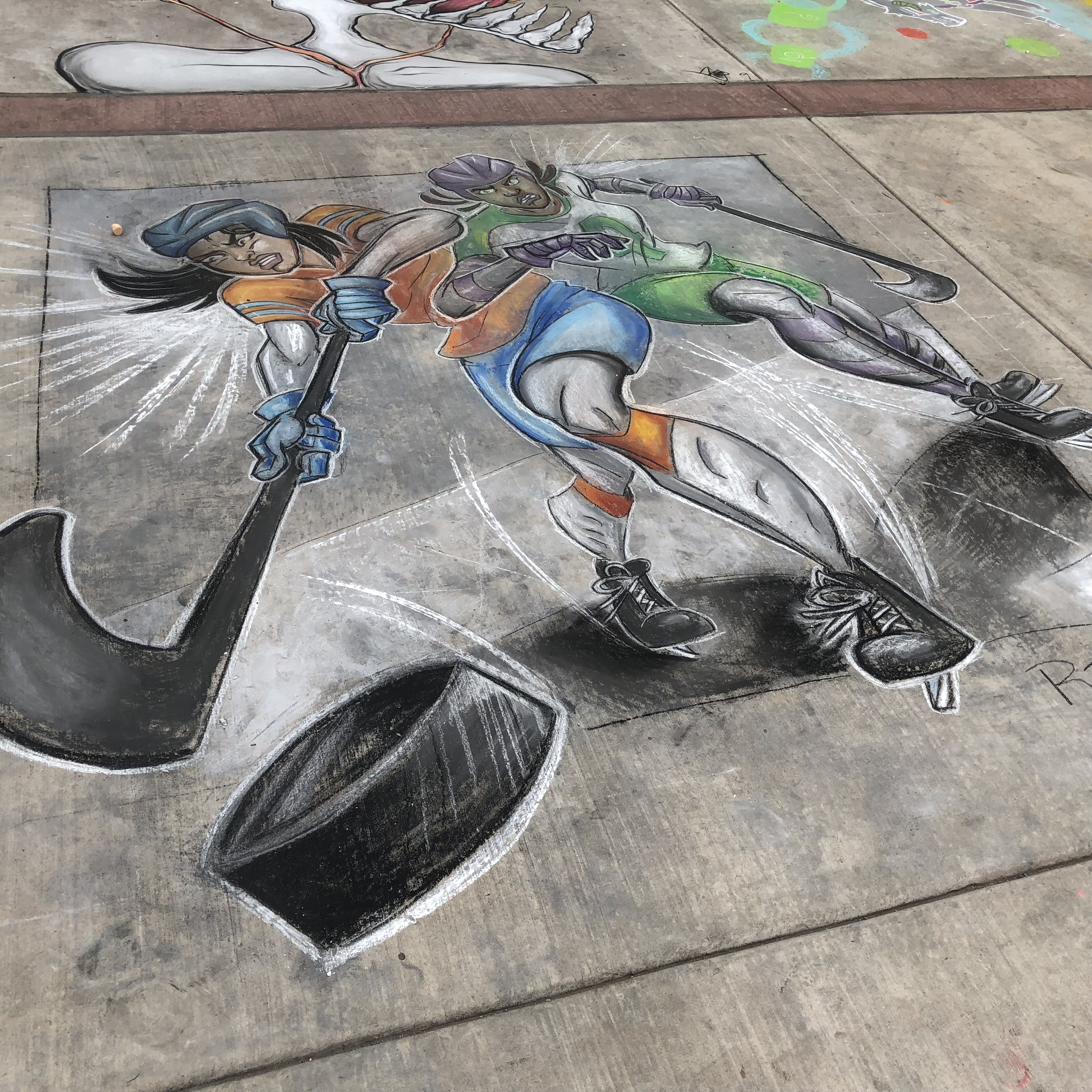
Rayan Turner, the winner of the first two competitions, and this year’s third-place finisher said that in this show he was trying to incorporate more figures and perspective. He went on to say that the event was just fun because it wasn’t often that he got to be with other artists.

Rayan Turner at work
Rayan Turner
Final Product

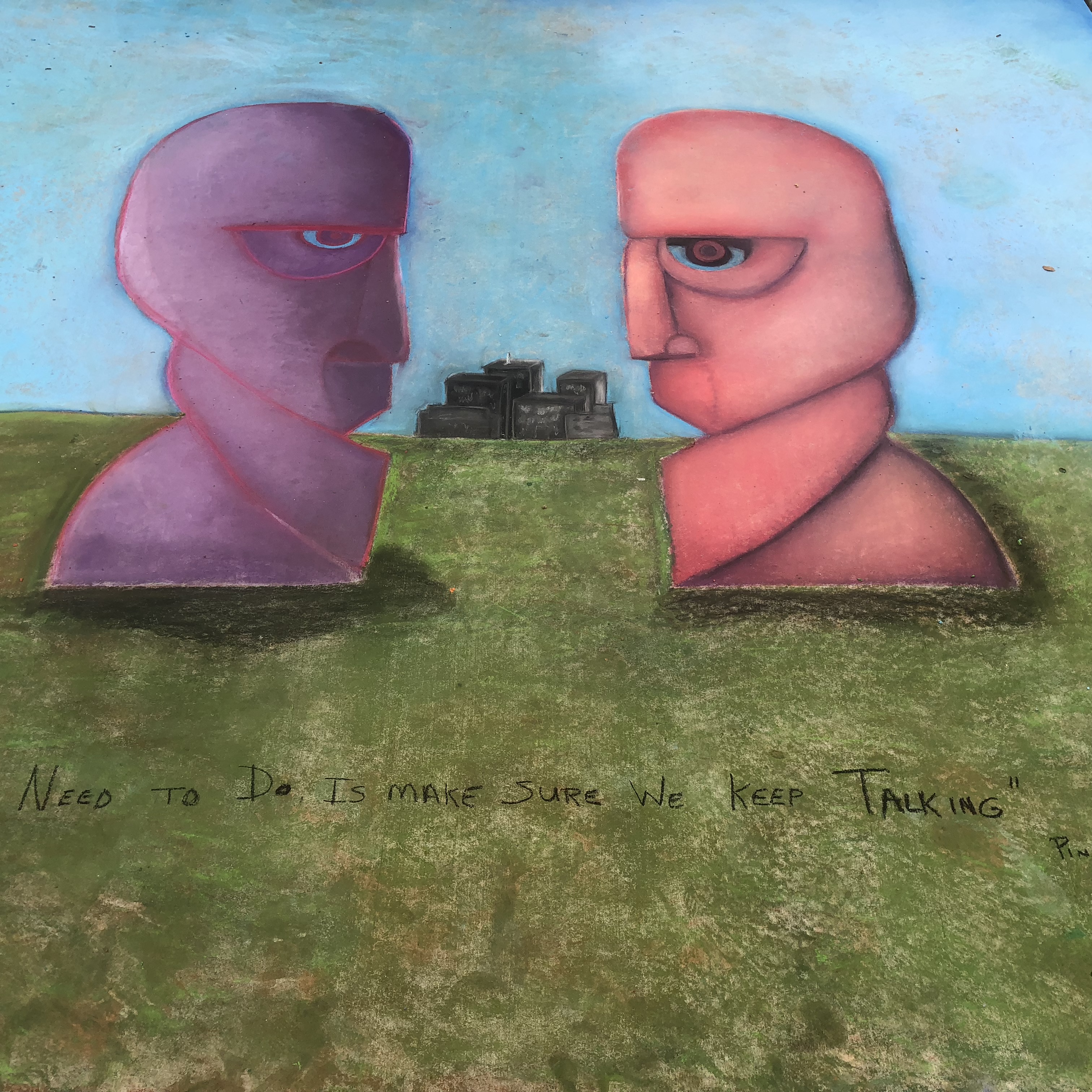
Judith Ortega and Gentry Phillip drew their inspiration from a Pink Floyd song entitled “Keep Talking,” certainly a mantra for this modern age. Though totally different and diverse, like the two Easter Island monoliths, we won’t be divisive as long as we communicate. Hear that Washington?

Judith Ortega and Gentry Phillip
“Keep Talking”

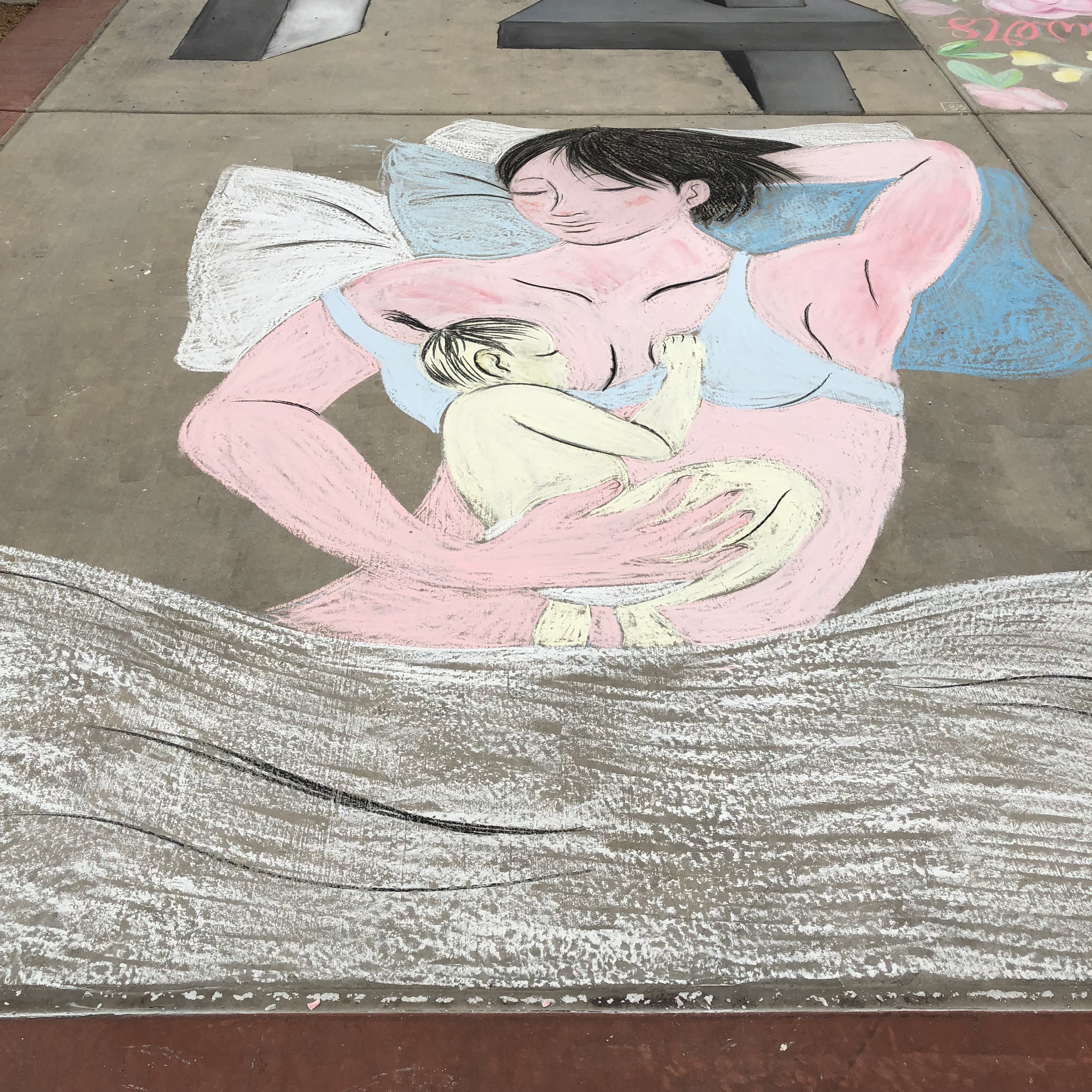
Ken Tackett of Praeclarus Press, reprised part of a series in the “Art of Motherhood,” representing the bonding between mother and baby in breast feeding. Though of the utmost relevance, the representation hardly conforms with expectations consistent with the Panhandle’s ostensibly conservative clime, a normal occurrence with local art.

Ken Tackett

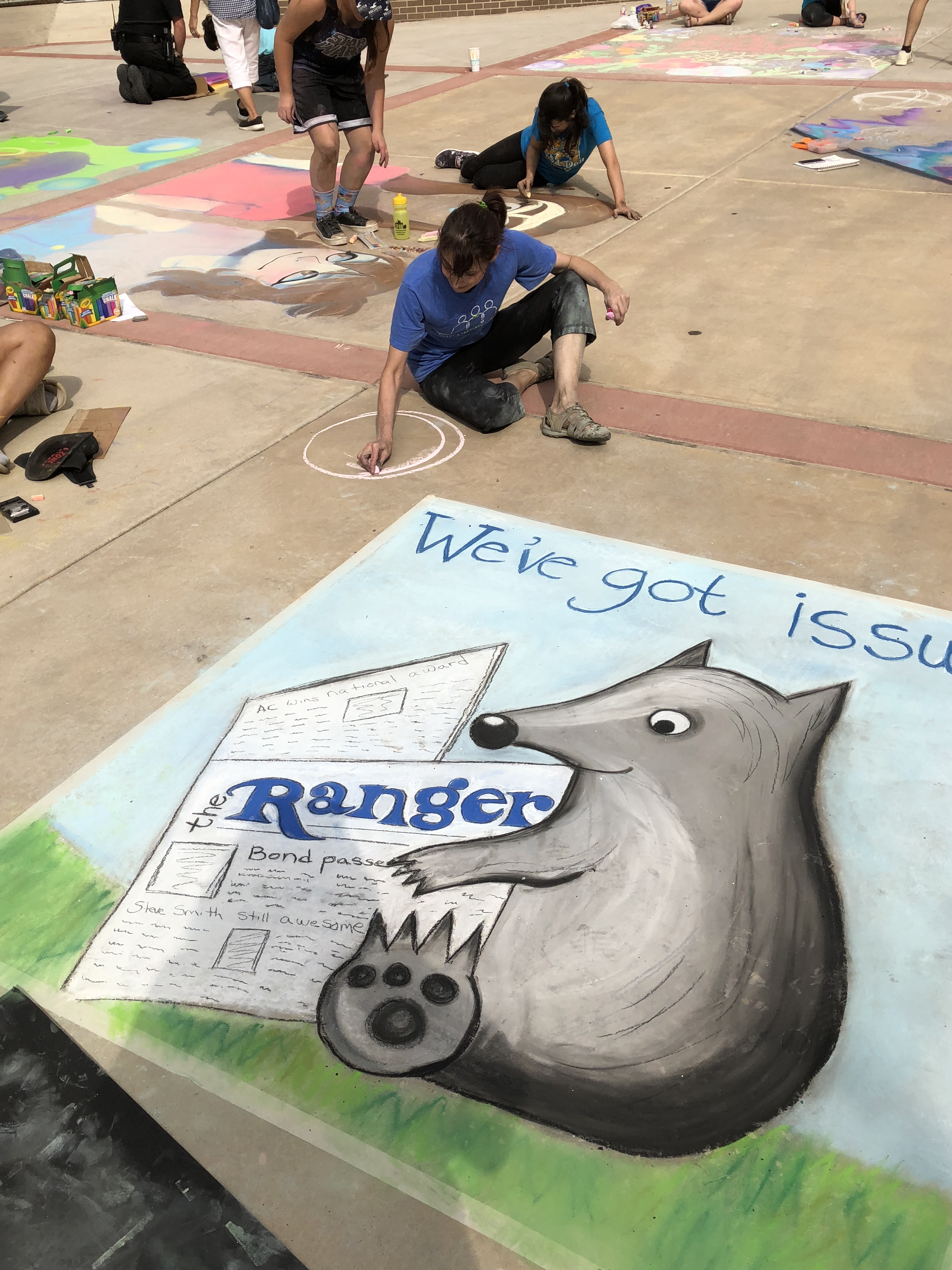
Jill Gibson, puissant professora of journalism, demonstrated another facet of her Renaissance Woman profile by doing a first time chalk-up plug for the “Ranger,” the college rag, and the Badger, the school mascot.

Jill Gibson

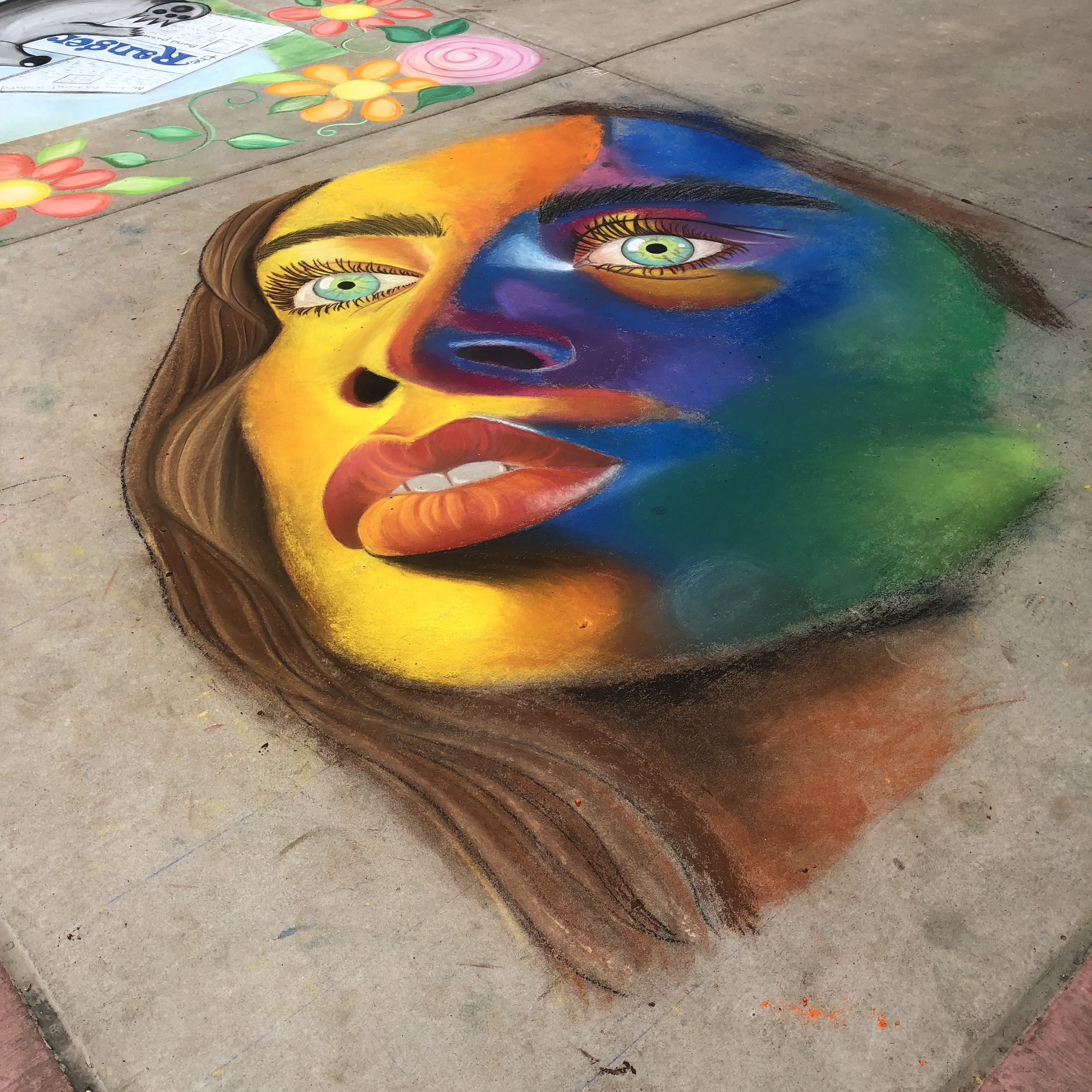
Another first time for chalk was done with striking results by Evette Hall and Yvonne Dominguez, dramatically rendering a woman’s face through the range of spectral variegations.

Finally, and just for fun: Casey Williams portrait of Chris Farley is truly extraordinary!

Extraordinary describes the entire event. Hundreds of visitors and scores of families showed up to view the artists and their art, which paletted Oeschger Mall for days. Already commitments have arrived for Chalk It Up No. 4, and even more! Remember: the last Saturday in July! It’s now a tradition.

Thanks to Amarillo College and Public Broadcasting for hosting this event. For this, and so many like it, we can say with gratitude and pride, “Keep Amarillo Artsy! Keep Austin Weird! Keep Lubbock in the Rear View Mirror!!!

The Galleries at Sunset: August 2, 2019

Amarillo, through most of this millennium, could boast of housing, in the old Sunset Center, the largest indoor art gallery in North America.

These bragging rights have been completely squashed by recent actions by the Crouch Foundation and the realities of a sixty-year old commercial structure.

The Galleries in the Sunset resulted from a decision by final owner Anne Crouch, an artist herself, to rent affordable studios to artists, some, doubtless starving. Ultimately, artistic exhibition characterized nearly the entire complex.

A major event on the city’s cultural calendar became the monthly First Friday Art Walk. Artists held evening hours for a casual come-and-go where the public viewed all forms of visual art that ranged the qualitative spectrum. Nowhere in the state offered such artistic variety and nowhere was such quantity of different art found on the continent.

Refreshments were found in many of the enclaves, and peripatetic musicians entertained throughout the big L. One of the most memorable occurred only this last February when the Opera Cowgirls from the Big Apple mixed the Grand ‘Ole and Metropolitan and probably punched a few more roof holes by their high notes.

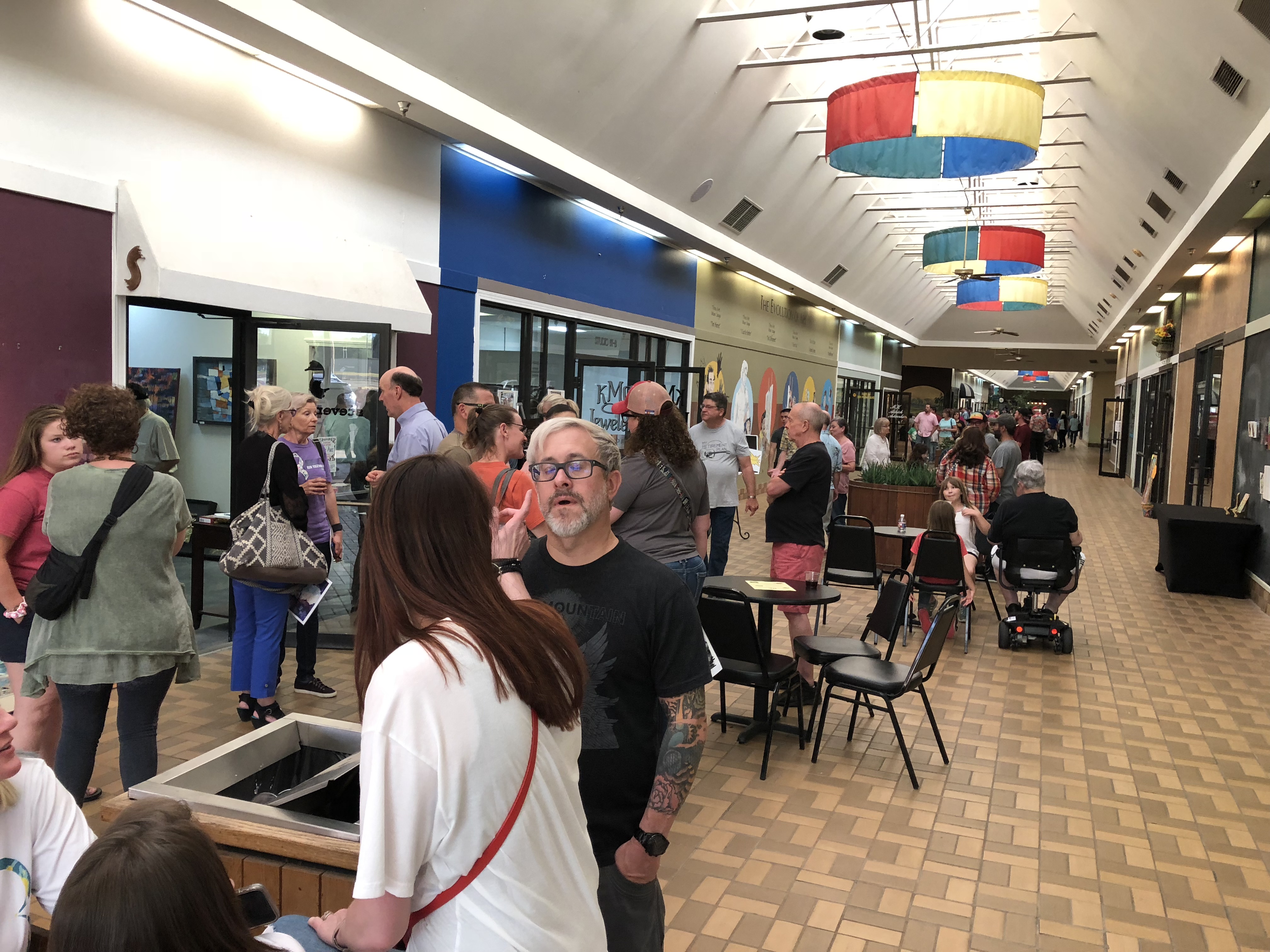
But this cherished and unique Amarillo institution is going the way of oblivion, with the last first Friday held only last night with visitors paying their final respects to the small remnant of remaining galleries. In fact, the July event, though well-attended, had all of the excitement of a wake.

An even larger, and certainly more energetic crowd was at this final First Friday, which had the vibe of a celebration of life. A portion of the throng at the north entrance is seen in the photo. And, folk were seen carrying out a lot of artwork, as remaining gallery owners off-loaded inventory at garage-sale prices.

We will miss the kaleidoscopic coloration of Steve Cost, whether in landscape or abstraction. Steve is a talent worthy of Santa Fe’s Canyon Road, but since 2003 his gallery has nailed down the north end of the mall.

Steve Cost
Artist Extraordinaire


As artist Karen Herpich says, “this can’t be replaced!” She went on to say, in effect, that its existence was a serendipitous consequence of art meeting opportunity to create the largest creative melting pot under one roof on the continent.

Yet, the exigencies of the 501c3 status sought by the Crouch Foundation and the necessity of renovating a sixty-year old building consistent with code ultimately dominated the decision to probably demolish most of the complex.

Many were and are asking the pertinent question about how this action aligns with Anne Crouch’s vision and dream.

Amarillo will likely not realize what it truly possessed until it beholds a field of packed caliche where once a structure commanded the artistic attention of North America.

Rachel Edwards: Artist Extraordinaire! July 21, 2019

Rachel Edwards personifies the enigma of artistry in Amarillo, meaning, “that which isn’t supposed to exist here, does!” Two recent exhibitions illustrate this point.

Art in the Alley
June 29, 2019

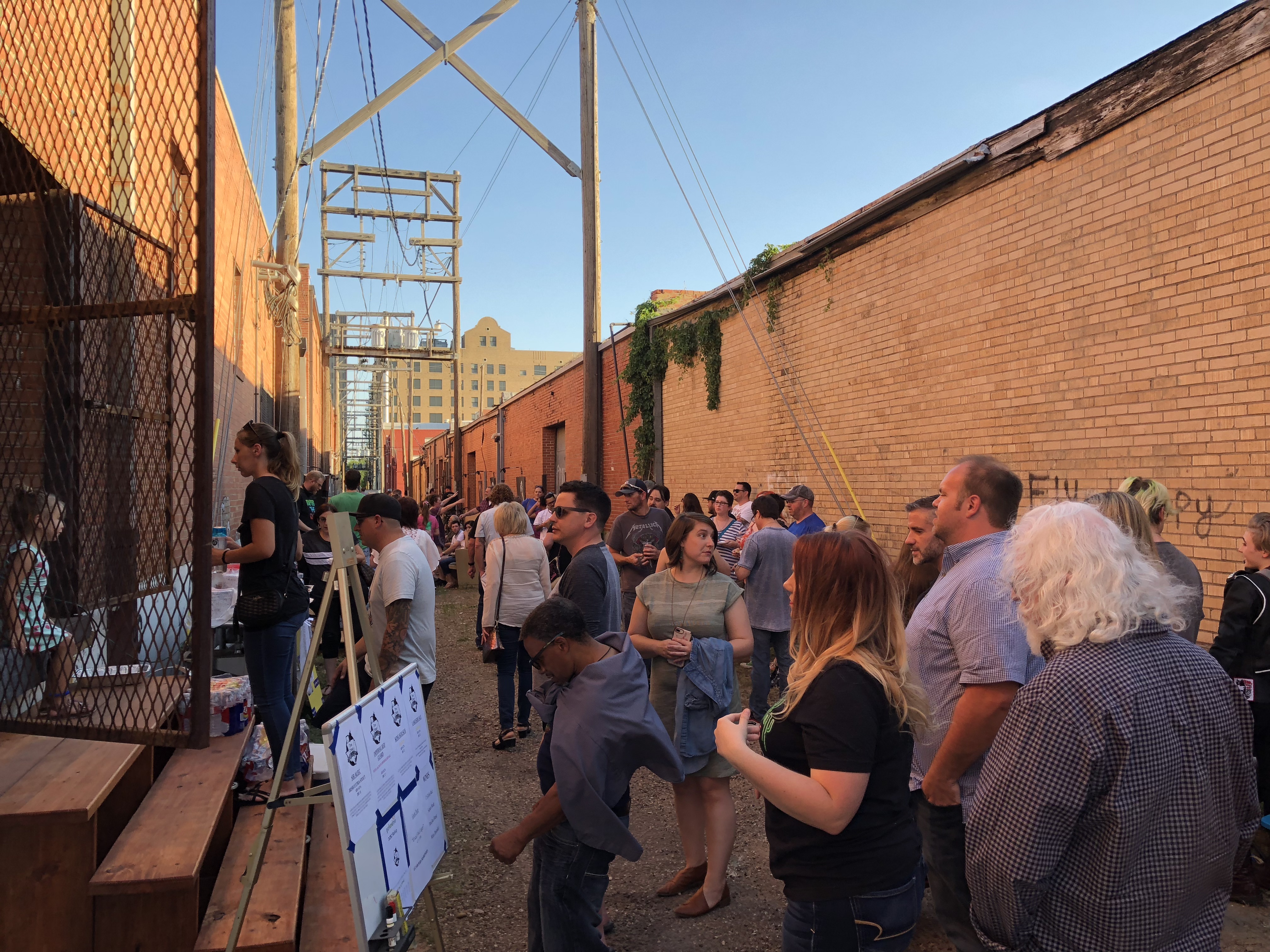
Industrial warehouse alleys, right-angled to railroad tracks contraindicates culture, or so common sense asserts.

But, why be common or normal? How about an alley gallery for something refreshingly contrarian?

That’s what Rachel did on June 29th, in her fourth exhibition of alley art.

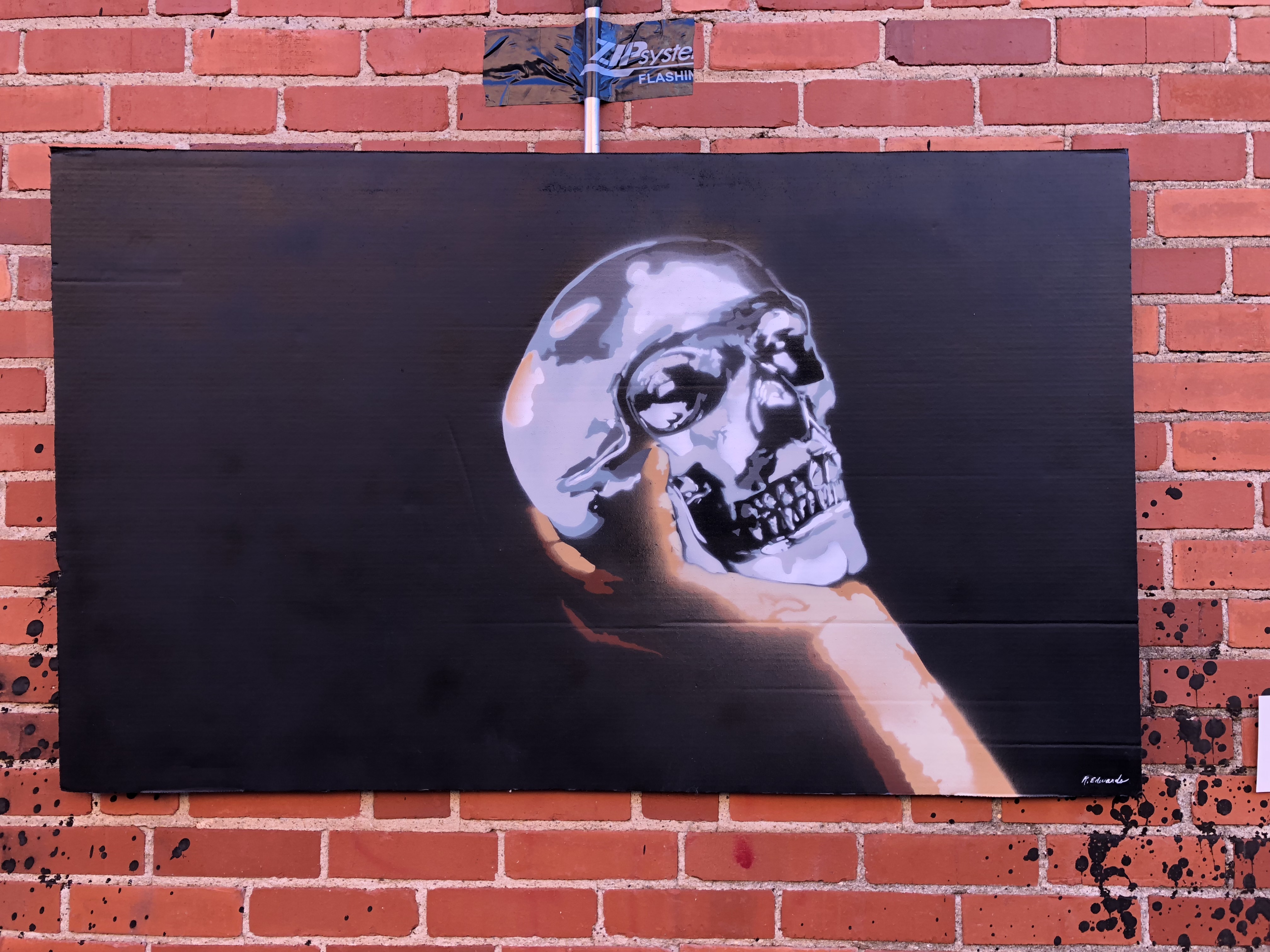
Her impulse was to find that sweet spot between high and pop culture, where the public could view Renaissance redux and other reformations and transformations sans affectation, art-speak, and exorbitance. Just beer on tap, boxed wine, pot-luck, and the amazing artistry of spray paint on cardboard under solar light.

Oh, and throw in a DJ and sound system and upwards of a hundred folk at a time enjoying themselves, families with small kids included.

Just survey this sampling of alley art from our local phenom of creativity.

I Knew Him Not
Broad and Empty
Bend
Venus Minus

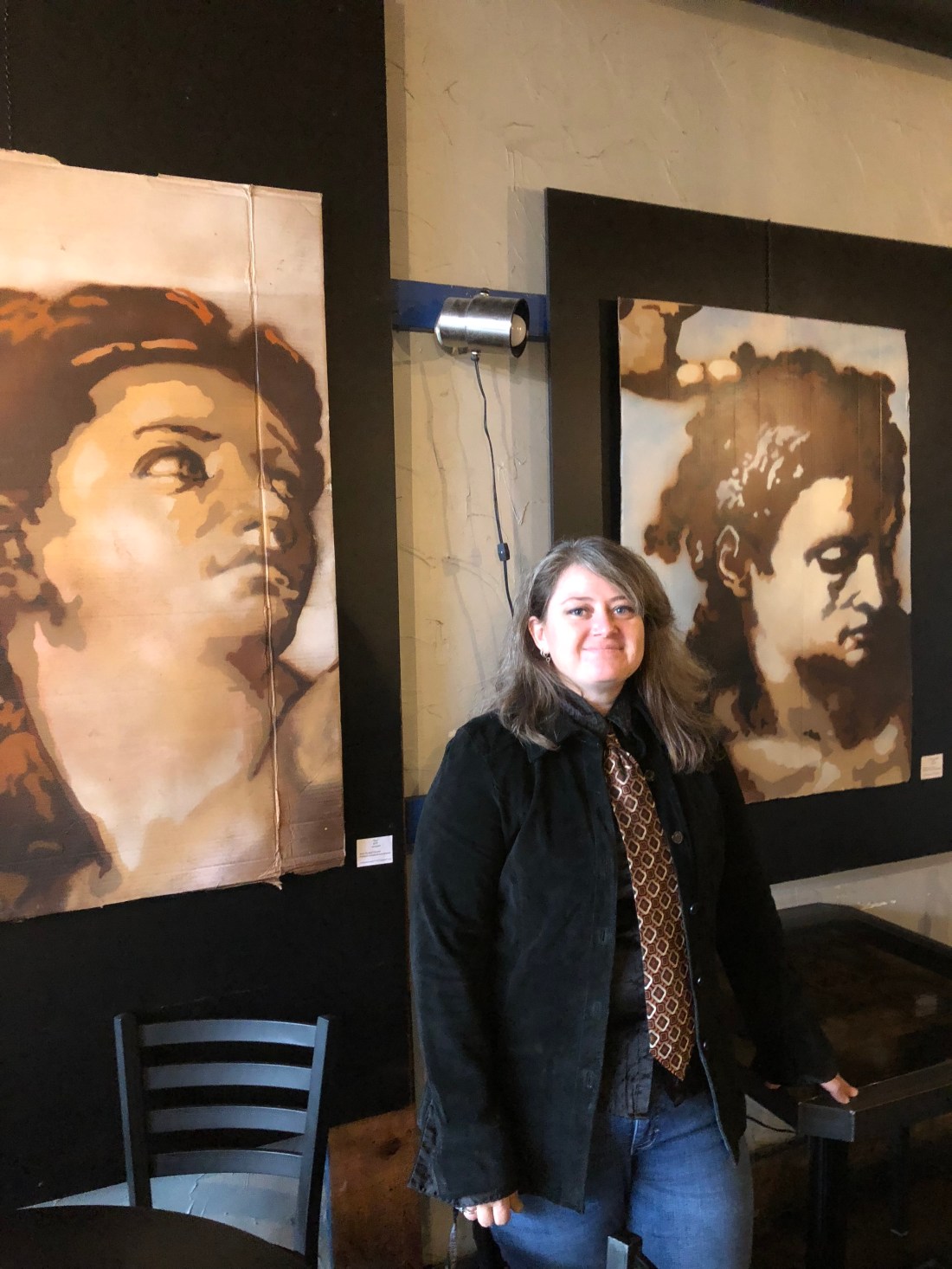
On Friday, July 5th, Rachel showed at the 806, a Bohemian-retro 6th St. coffee shop for the free-thinking fringe, of whom supposedly conservative Amarillo has a multitude.

This show featured survivors from Alley Gallery #3, described as the “Sistine Sans Ceiling.” Two of the works are Renaissance recreations, but the rest are just fun. Take a look-see.

Space Race
Spray Paint on Masonite
Melting Point
Happy Face

The artist has remained true to her convictions of bringing the art of haut culture to a wider audience. The fear is that she’ll take her amazing art to a bigger burg where the base for appreciation is larger.

Contact her on instagram @ rachaeledwardswithpaint, or email rachaeledwards777333@gmail.com.

Amarillo is fortunate to have Rachel Edwards and hopefully she’ll keep creating with spray paint and cardboard, and we’ll keep saying, “Keep Amarillo Artsy! Keep Austin Weird! Keep Lubbock in the Rear View Mirror!!!!”

July 8, 2019: Merely Players – “Above the Sun.” AC Experimental Theatre

Above the Sun
AC Experimental Theatre
June 28, 2019

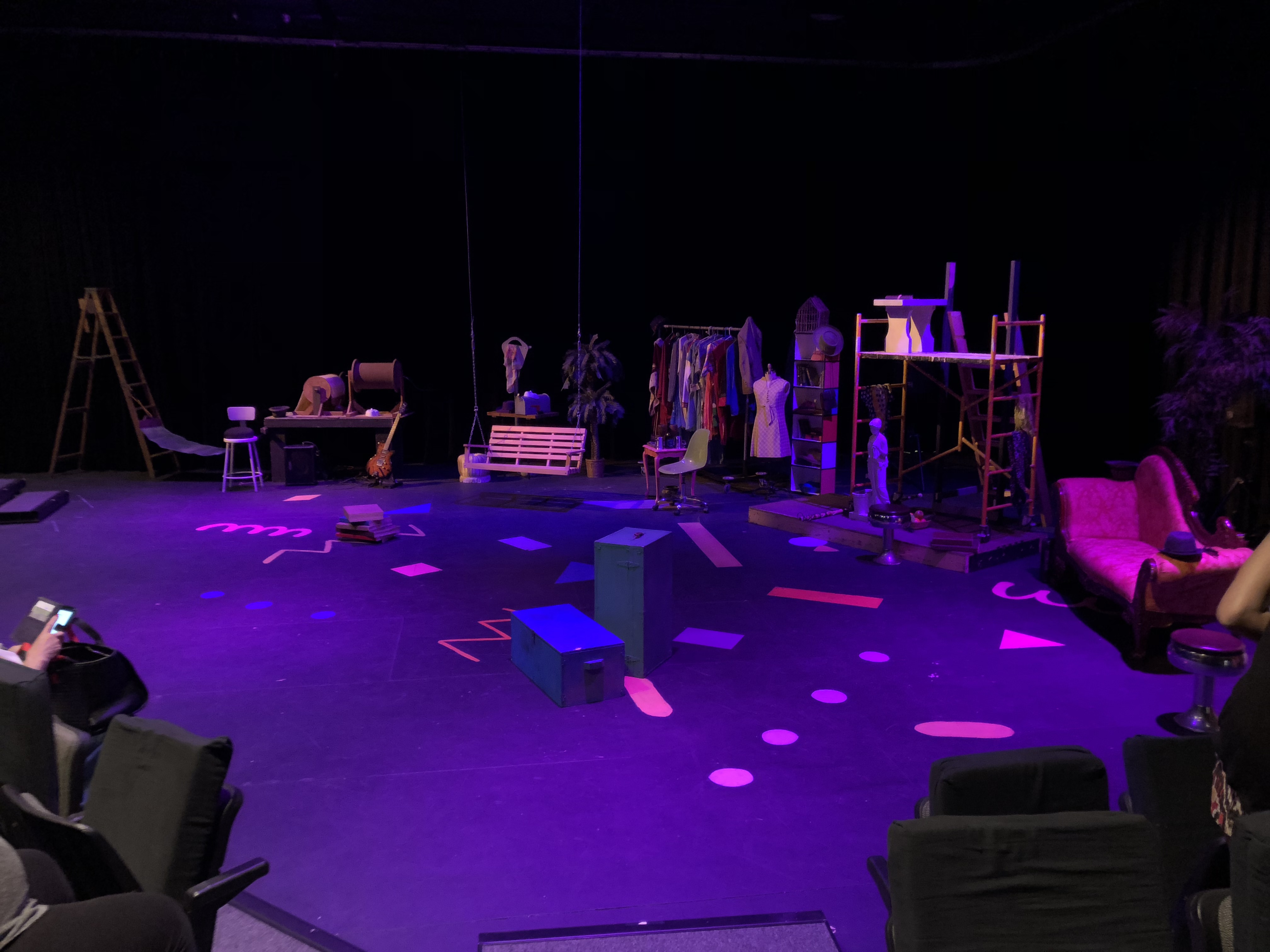
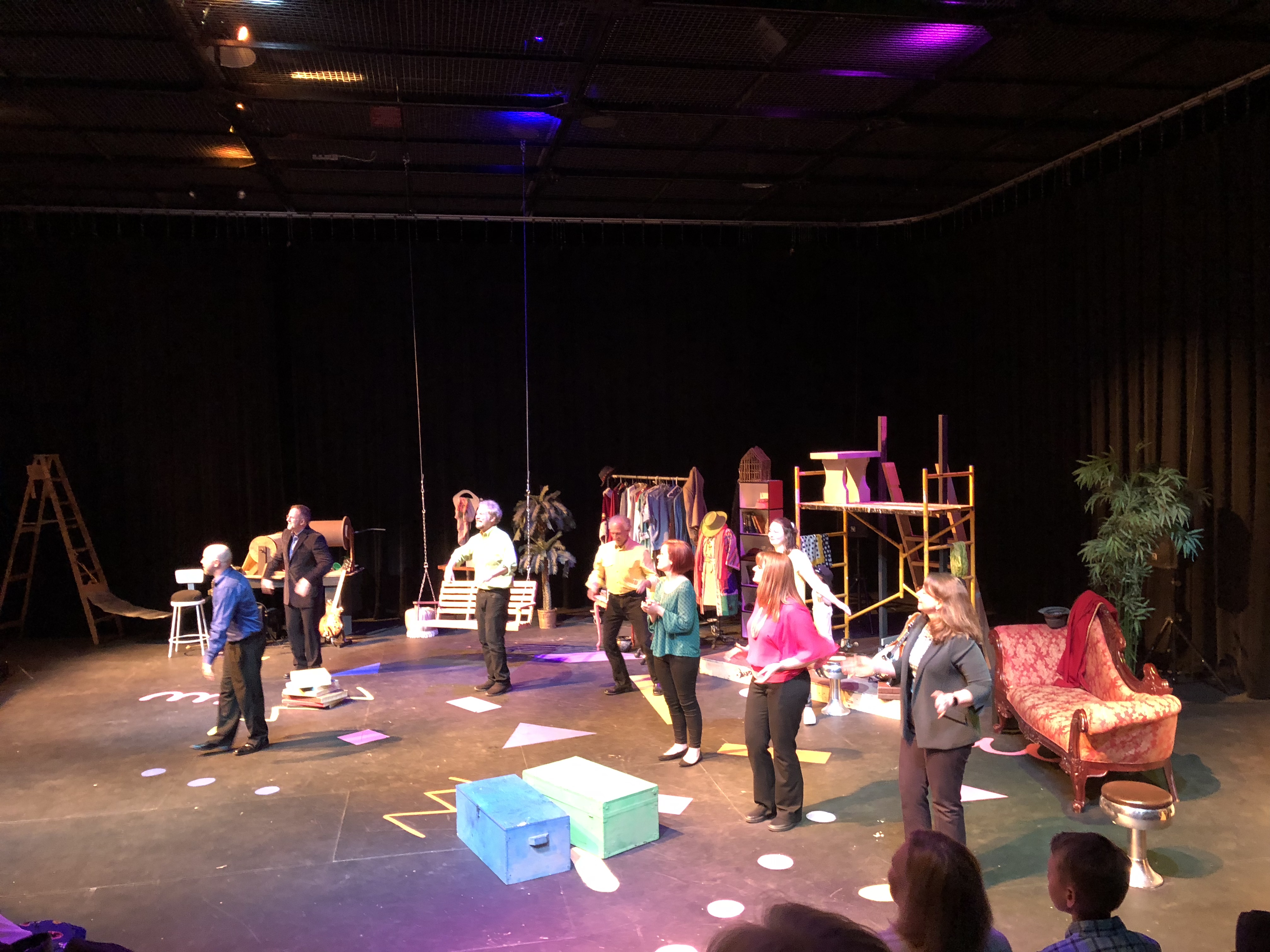
Think Godspell, then think Old Testament, along with totally local; but don’t think church service. Voila, you then have Above the Sun, originally written by Amarilloan Heidi Stricker, with lyrics by Dean and Stacey Yates and performed by “Merely Players,” Panhandle people all.

The playwright’s self-imposed brief, was to humanize the characters of the Old Testament, or, in her words, “It is when we hear the prayers of these people that we realize they ask the same questions and feel the same emotions we do.”

And, to reference our Protestant Sunday-school inculcating, the themes of the Man and God dialogue are three-fold. First, God, You’re Great! Second, “If You’re Omnipotent, why does life dump on me?” Then, conversely, “You can deal with it – think big picture!”

The challenge for Merely Players, a group of avid stage aficionados who perform one or two plays a year, was eliciting dramatic feeling from protracted passages taken from earlier biblical versions. Even though the language is often archaic, the cast performed admirably, especially as some of the monologues are protracted and require no little thespian talent for delivery.

The narrative is pushed by Wisdom, who, in this performance was superbly played by understudy Stacey Yates. Ensuing selections, all thematically consistent, might be drawn from just one passage, or, in the case of Cry Aloud to the Lord of Hosts, from eleven different Old Testament books.

Above the Sun
Full Cast Chorus

The play pops when song elaborates the spoken word. Two numbers merit mention. A Prayer of Habakkuk was sung by a finger-snapping Blues Brothers-type trio whose dark glasses and straw fedoras amplified the message: “I’ll rejoice in the Lord!”

In A Capable Wife, female cast members dressed a mannequin in a layered ensemble. This scene and song showed a nice piece of directional artistry and, most definitely, the magic of a woman’s touch.

This play, like Godspell, appeals to both the spiritual and the secular and deserves wider currency. And, the fact that it is purely Panhandle in creation and production ought to provide greater purchase in staging decisions.

A theatre-hungry audience, who also see this play as a teaser for the opening of the arts season in a couple of months, says “Thank you!” to Merely Players and Amarillo College for whetting our appetites for the nearly forty plays staged from September through May.

And from Above the Sun, to all of the creativity that exists under the Panhandle sun, we say: “Keep Amarillo Artsy! Keep Austin Weird! Keep Lubbock in the Rear View Mirror!!!”

July 1, 2019: Current Exhibition @ the AMOA

Loaned Works
Blanton Museum of Art

The exhibition at the Amarillo Museum of Art featuring current acquisitions and works on loan, belies the reputation that this area only elevates western art.

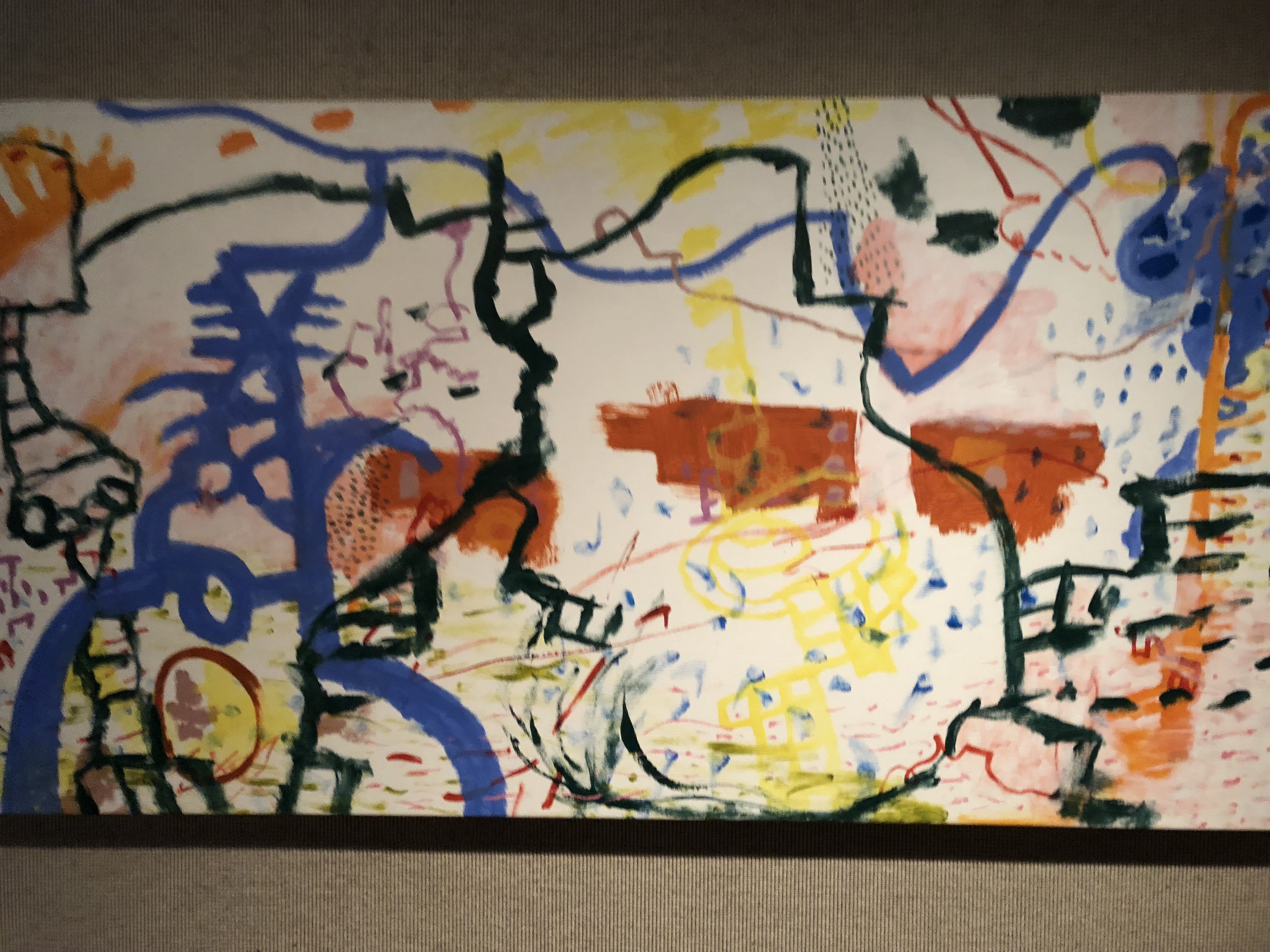
In fact, the displayed works works reveal an institutional character that is, in effect, progressive, post-modernist and eclectic. A sampling will underscore these qualities.

“Hamilton Holding”
John Himmelfarb

“Hamilton Holding,” by John Himmelfarb, is a Kandinsky-esque work acquired as a gift from James A and Geraldine Zorn. AMOA’s association with the artist goes back to “The Trucks of John Himmelfarb” exhibition in 2015.

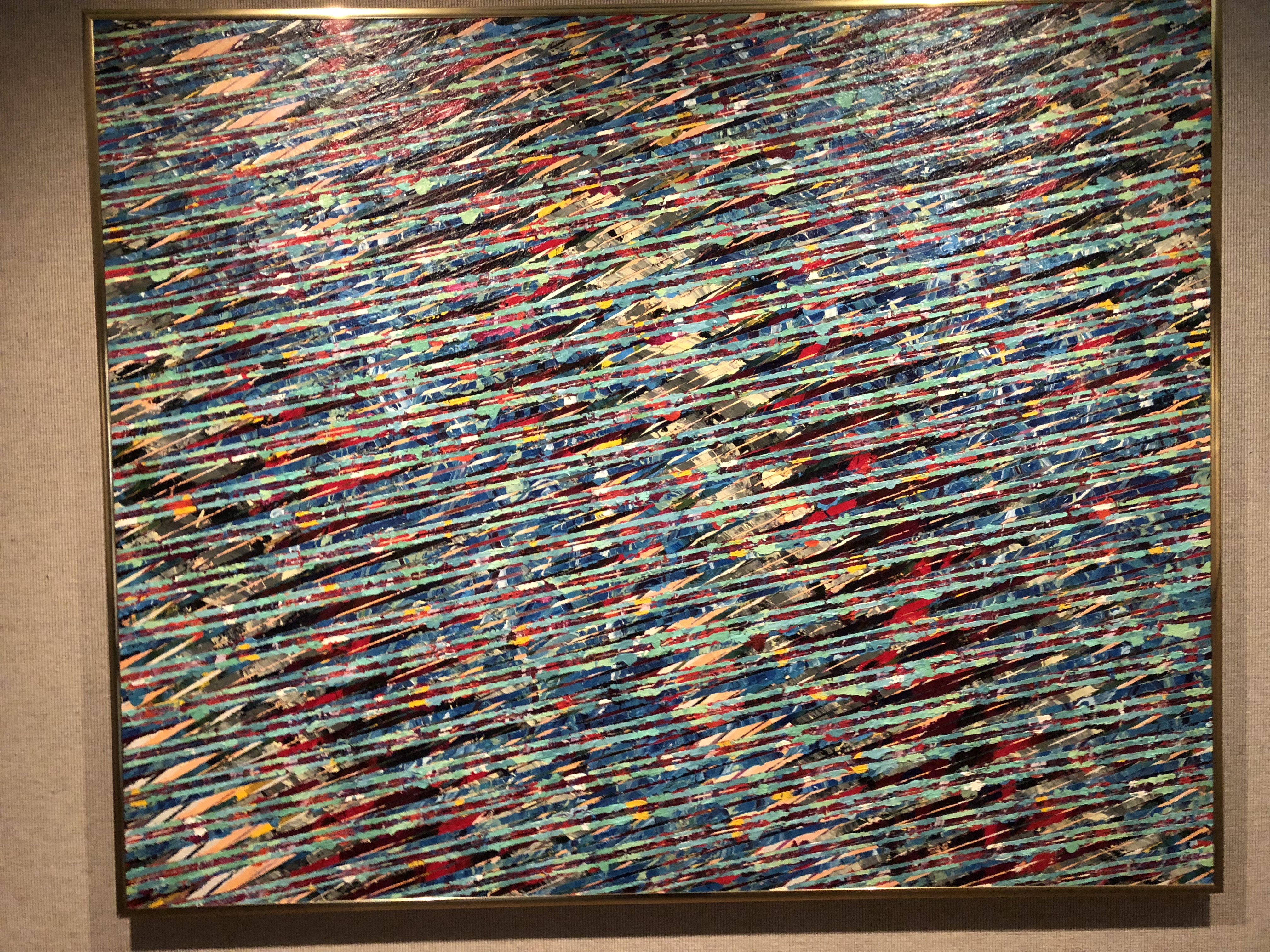
Aaron Karp
Blue Flicker – 1982

Aaron Karp’s Blue Flicker, 1982, a gift from the Blanton Museum of Art and Tim Jarvis, is a linear collation of textures and chromatic melds. In the words of the artist, “It is about the fracturing of color and space, about looking at and into something to extract information and meaning.”

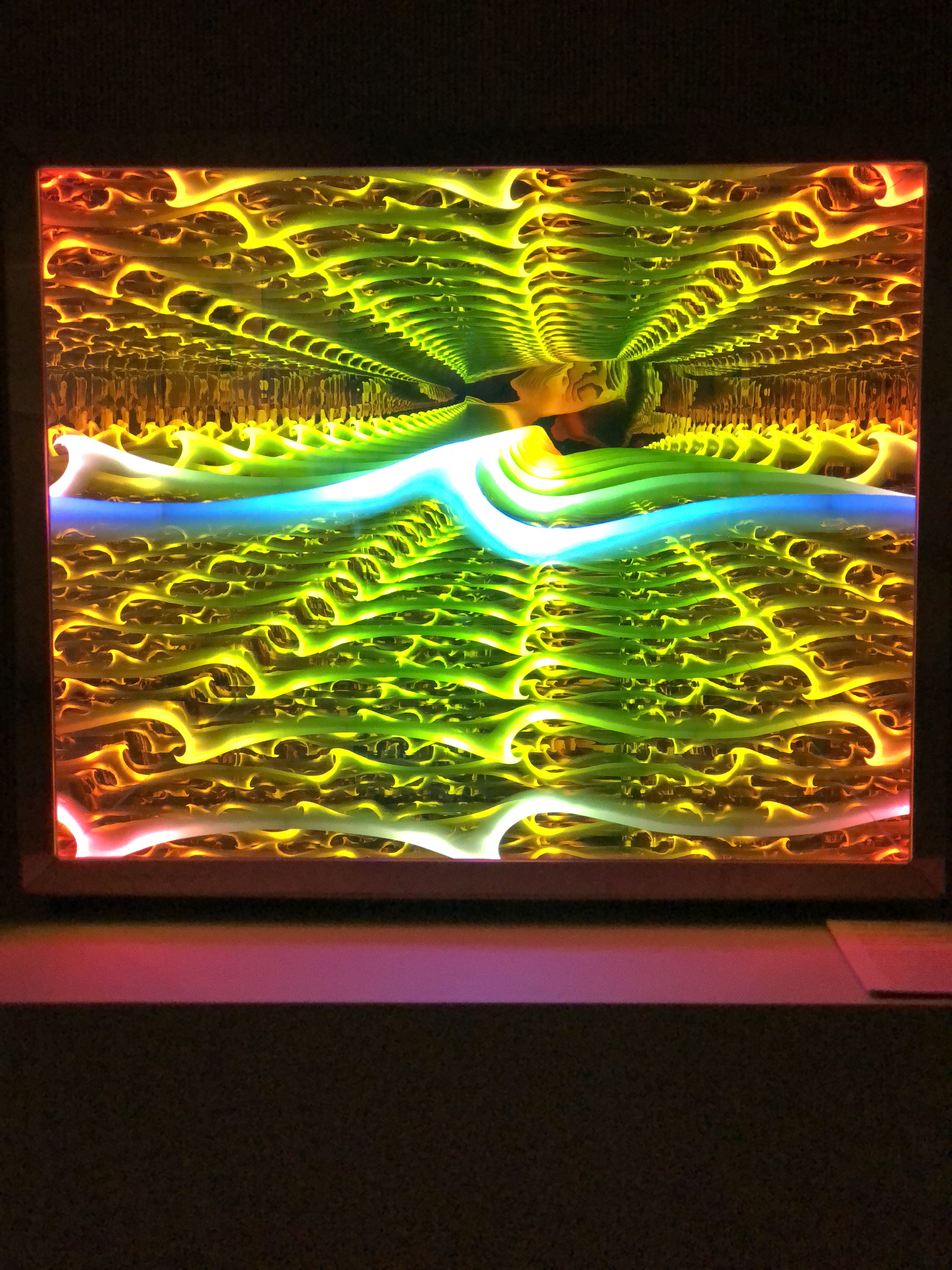
Ray Howlett
Ocean Waves, 2007

Ray Howlett gifted Ocean Waves, 2007 to AMOA. This piece, reminiscent of Dale Chihuly, is a dichroic glass and metal op art construction that beckons the viewer into the endless. Part of Howlett’s oeuvre which he calls “Contained Reflective Light Sculpture,” this work will become a focus of fascination whenever featured by the museum.

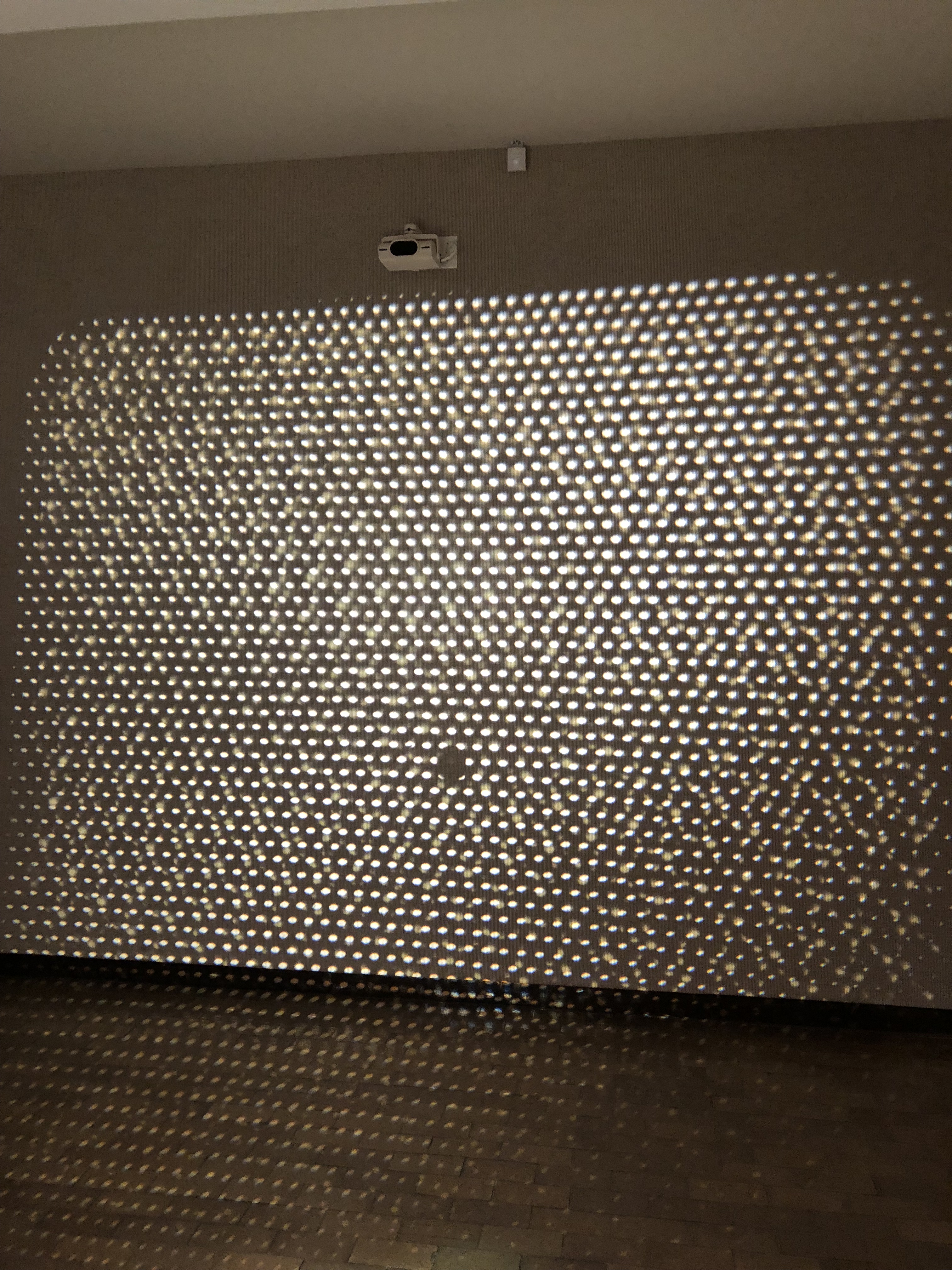
Barna Kantor
Retinal Message 2004

And, speaking of trompe l’oeil, Barna Kantor’s, Retinal Message 2004, another gift from the Blanton with funds donated by the Director’s Circle, definitely tricks the eye and messes with the mind. Endless wall permutations result from the interaction of rotating perforated disks atop twin overheads, a sure bet to mesmerize kids of all ages.

Image Makers
Retinal Message

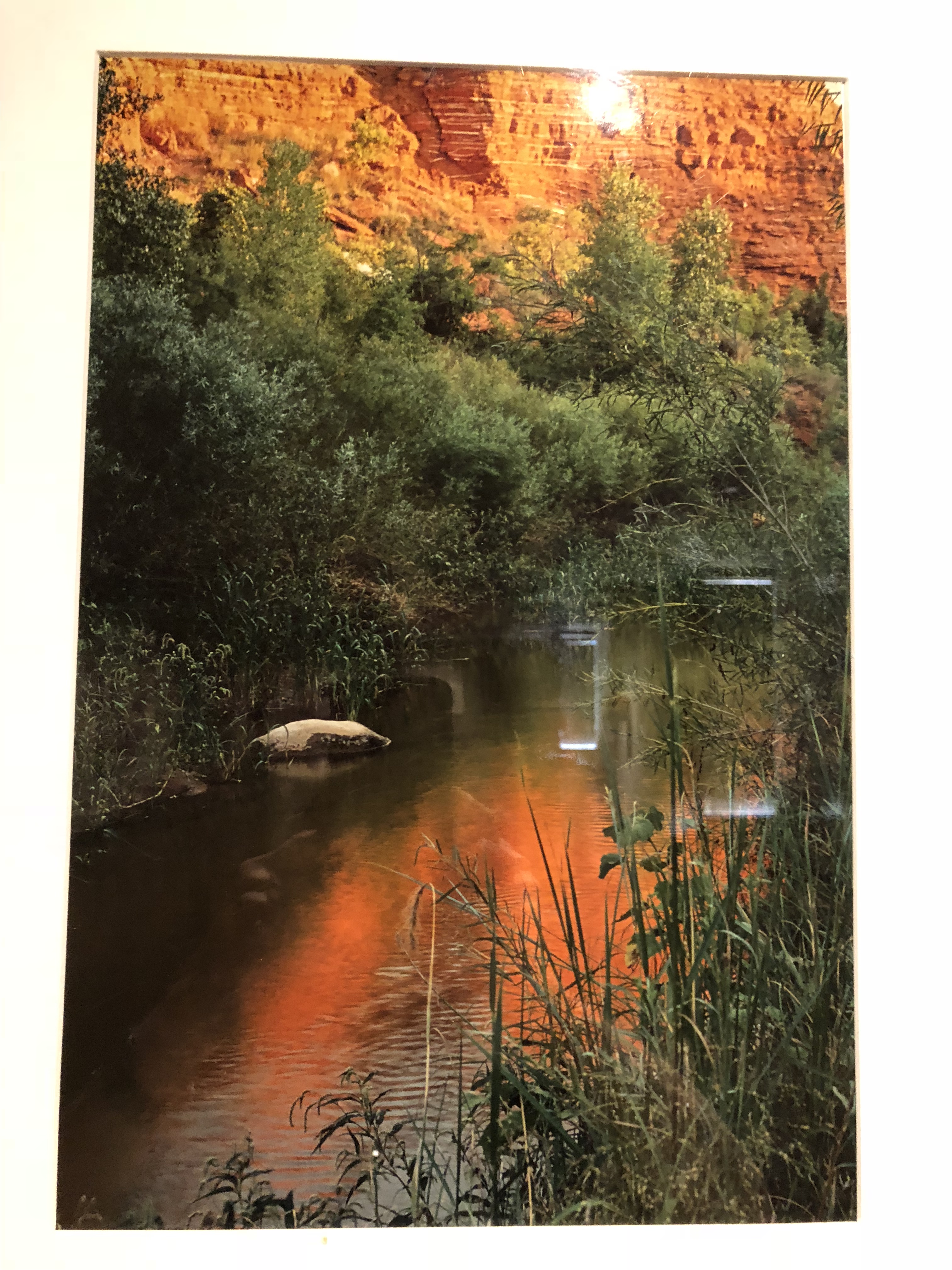
A nod to Amarillo’s own are the incandescent landscape photos of Jim Jordan, whose provenance includes residence at a German Schloss. We’re glad these works of art are back home where they belong.

Landscape
Jim Jordan
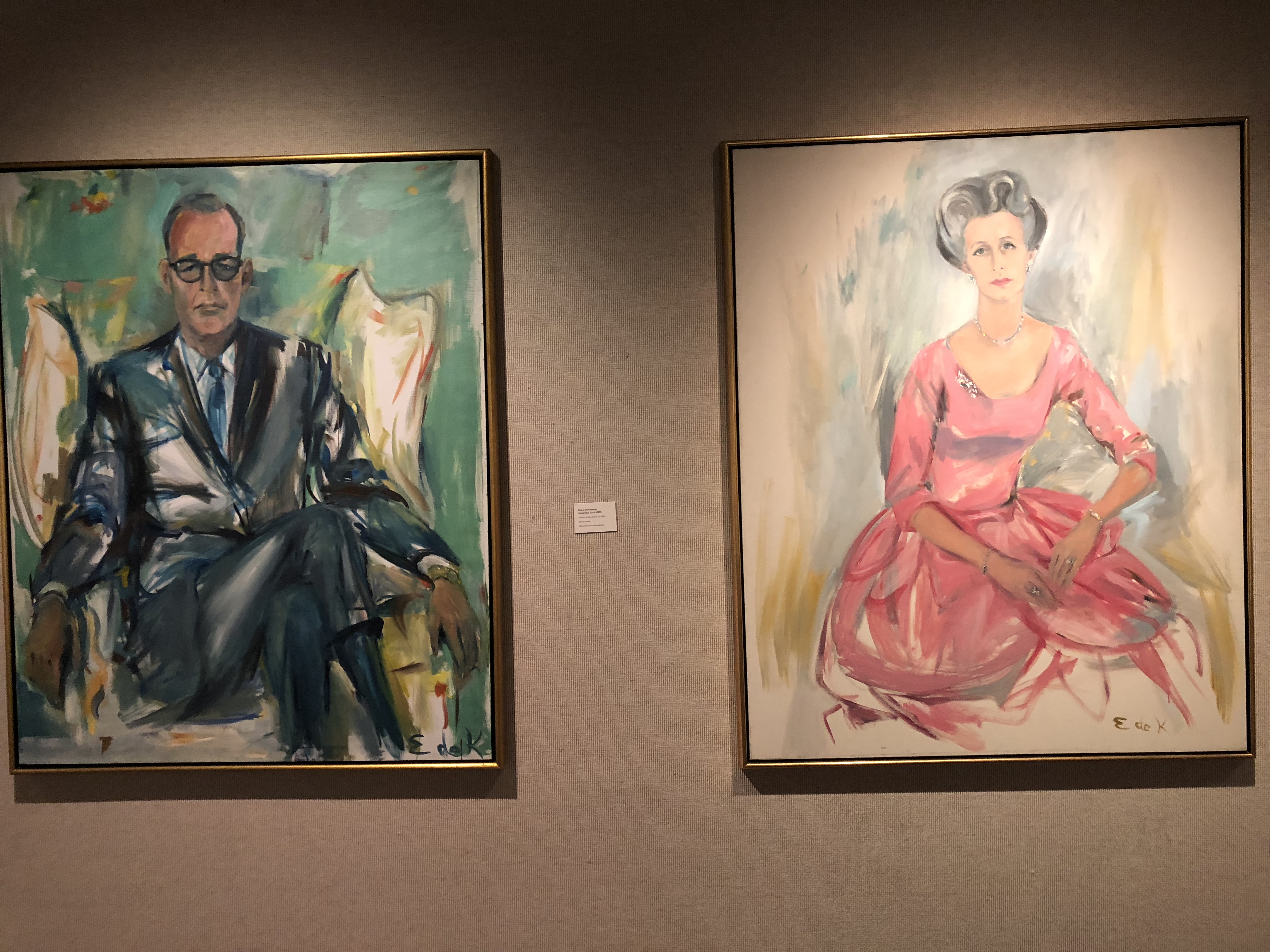
Elaine De Kooning
Portraits of Lee and Betty Bivins

The generosity of Mike and Dalia Engler and the Bivins Family Foundation has resulted in AMOA acquiring not one, but three works by Elaine De Kooning: Taurus XIV and portraits of Lee and Betty Bivins. This artist also painted the iconic image of JFK.

These works accrete to works in the permanent collection by O’Keeffe, Frankenthaller and Nevelson, amounting to a veritable Who’s Who among American women artists of the twentieth century.

Judy Chicago
Big Blue Pink, 1971

And, in this context we must mention the Judy Chicago’s work, Big Blue Pink, 1971, currently on loan from Art Bridges. Next year AMOA hosts an exhibition of her work, an unexpected event for the red-based high plains considering the unambiguous assertion in many of her pieces.

The philosophy behind these acquisitions, whether temporary or permanent, bespeaks both openness and outreach, not prairie provincialism. The quality and diversity of the works show that the AMOA is certainly doing its part to “Keep Amarillo Artsy! Keep Austin Weird! Keep Lubbock in the Rear View Mirror!!!!”